
Retirement in Mauritius: Should You Buy or Rent?
Moving to Mauritius for retirement raises one very practical question: Should you buy a home, or should you rent?
For many people, owning a home has always represented security. You own something permanent. Nobody can ask you to leave when the lease ends, and you can decorate, renovate and organise the property exactly as you wish.
But retirement changes the calculation.
The best housing decision is no longer necessarily the one that builds the most wealth. It may be the one that gives you the greatest freedom, the most reliable monthly budget and the least amount of stress.
There is no answer that is right for everyone. However, for someone retiring in a new country, renting first often makes a great deal of sense.

Retirement Is Not the Time to Prove Anything
Some people still see renting as a sign that they have failed to become financially secure.
That idea is outdated.
Renting and owning are simply two different ways of paying for a place to live. Each provides different benefits, responsibilities and risks.
When you buy a home, you are purchasing an asset. You may benefit if its value rises, and you gain greater control over where and how you live.
When you rent, you are purchasing a service. You are paying not only for accommodation, but also for flexibility, maintenance, convenience and the ability to move without selling a major asset.
The important question is not: Which choice looks more successful?
It is: Which choice will give me the retirement I actually want?
Why Buying in Mauritius Can Be Attractive
Home ownership can provide an important feeling of permanence.
Once you have found an area you love, buying means that you do not have to worry about a landlord deciding to sell the property or refusing to renew your lease. You are not exposed to annual rent increases, and you can make the home your own.
You can replace the kitchen, change the bathroom, improve the garden, install better air conditioning or redesign the property around your future needs.
Owning may also help you feel that Mauritius is truly your home rather than somewhere you are temporarily staying.
Over the longer term, the property may increase in value. It can become part of your estate and eventually be left to your children or other beneficiaries.
For someone who is financially secure, understands Mauritius well and expects to remain in the same place for many years, buying may be a perfectly sensible decision.
But Foreign Buyers Face Additional Rules
A non-citizen cannot necessarily arrive in Mauritius and buy any house or apartment offered for sale.
Foreign property ownership is governed by the Non-Citizens (Property Restriction) Act. Depending on the property, a non-citizen may need approval or may have to buy through an authorised route, such as an Economic Development Board property scheme or another qualifying category. (EDB Mauritius)
The authorised routes include developments such as the Property Development Scheme, Smart City Scheme and certain other approved residential projects. Qualifying apartments in buildings with at least two floors above ground may also be available to non-citizens, subject to the applicable conditions and approval process. (EDB Mauritius)
This means the property available to a foreign retiree may be more limited, and sometimes more expensive, than the wider market available to Mauritian citizens.
Buying should therefore involve a Mauritian notary and properly qualified legal and financial advisers. The purchase price is only one part of the calculation. You must also understand the taxes, duties, professional fees, service charges, maintenance obligations and rules affecting resale.
Owning a Home Does Not End Your Housing Costs
A mortgage-free home is not a cost-free home.
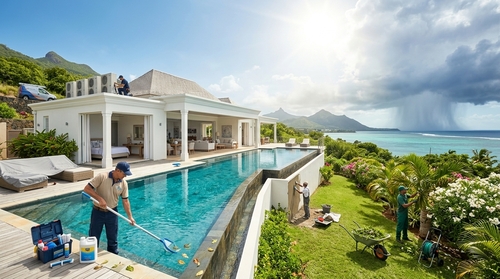
Buildings deteriorate. Appliances fail. Paint fades. Plumbing leaks. Air-conditioning systems require servicing and replacement. Gardens, swimming pools and exterior areas need regular attention.
In Mauritius, the tropical climate can be demanding on a property. Heat, strong sunlight, humidity, heavy rain, salt air near the coast and occasional cyclonic conditions can all increase maintenance requirements.
If the property is part of a development, you may also have monthly or annual management charges. These can pay for security, gardens, lifts, pools, common areas and other shared facilities.
Those services may be valuable, but the charges must be included when comparing ownership with renting.
A house may look affordable when you consider only the purchase price. It may look less affordable after including every expense over the following ten or twenty years.
Property Is Valuable, but It Is Not Liquid
A home can represent a large amount of wealth, but that wealth is tied up in the property.
You cannot use a bedroom to pay an electricity bill. To access the equity, you normally have to sell the property or borrow against it.
Selling can take time. You must find a buyer, negotiate a price, complete the legal process and pay the relevant costs. If the market is weak when you need to move, you may have to wait or accept less than you expected.
This matters in retirement.
A person can appear wealthy because they own an expensive home while still struggling with monthly cash flow. Having more of your capital available in savings or investments may sometimes provide greater practical security than having most of it locked inside one property.
A home can be an excellent asset, but it should not leave you short of accessible money.

Why Renting Can Be the Smarter First Step
Renting gives you something especially valuable when you first move to Mauritius:
Time to learn.
A place that appears perfect during a two-week holiday may feel very different after living there for six months.
You need time to discover what daily life is really like.
- How noisy is the neighbourhood?
- How easy is it to reach a supermarket, pharmacy, doctor or hospital?
- Can you manage without a car?
- Is the road congested during the morning and afternoon?
- Does the area become extremely busy during weekends and holidays?
- Is the apartment cool and well ventilated, or does it become uncomfortably hot?
- Is there construction nearby?
- Does the property have reliable water pressure, internet access, security and parking?
These are not questions that can always be answered during a property viewing.
Renting allows you to experience an area before making a large and difficult-to-reverse commitment.

My Own Experience of Renting First
When I moved to Mauritius in January 2026, I had already researched the country extensively. Even so, research could not tell me exactly what daily life would feel like.
I arrived after a journey of approximately 44 hours from Guatemala. At that stage, the last thing I needed was the pressure of making an immediate property purchase.
Renting gave me the freedom to settle in, learn how the buses worked, explore different coastal communities and understand which conveniences mattered most to me.
Before arriving, a map might suggest that two locations are almost identical. Once you live here, you begin to notice important differences.
One area may have a better beach but poor access to supermarkets. Another may be convenient but much noisier. One apartment may look attractive online but receive very little natural air. Another may be farther from the centre but offer a calmer and more enjoyable daily routine.
I have lived in twelve countries, and one lesson has remained consistent: You do not truly understand a place until you have lived there.
That is why I would be extremely cautious about buying immediately after arriving in Mauritius, regardless of how attractive the property appears.
Thankfully I found an awesome, extremely quiet and peaceful fully furnished three bedroom apartment for only 35,000 Mauritian rupees (about USD$745 or £550)
Renting Reduces the Maintenance Burden
One of the strongest arguments for renting in retirement is simple:
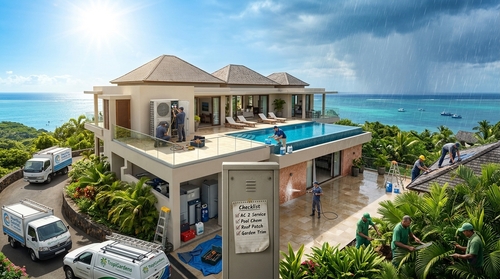
When something major breaks, it is generally the landlord's responsibility to deal with it, subject to the terms of the lease.
You may still have to report the problem, wait for repairs and occasionally deal with a slow or unhelpful landlord. Renting is not free from frustration.
But you are not normally responsible for finding the money to replace the roof, repair structural damage or install an entirely new plumbing system.
That can reduce both financial pressure and mental strain.
Retirement should ideally give you more time for the things you enjoy. You may not want to spend your days supervising contractors, collecting quotations, buying materials and worrying about the next expensive repair.
Your home should support your life. It should not become your full-time project.
Renting Also Preserves Flexibility
Your needs at 65 may not be the same as your needs at 75 or 85.
Today, you may be comfortable using stairs. Later, you may prefer a lift or a ground-floor apartment.
You may eventually want to live closer to a hospital, shops or family members. You may decide that you no longer want to drive. You may want a smaller property that is easier to manage.
Renting makes these changes easier.
It also suits people who expect to travel regularly. Leaving an owned house empty for several weeks or months can create worry about security, storms, leaks, gardens and maintenance.
A secure apartment in a well-managed building may be much easier to leave while travelling.
The Disadvantages of Renting Are Real
Renting is not automatically the safer or cheaper choice.
Your landlord can increase the rent when the lease is renewed. The property may be sold. The owner may decide to move back into it or stop renting it altogether.
You may have restrictions on pets, decoration, alterations or visitors. Maintenance may not be completed as quickly as you would like. You may also have noisy neighbours or weak property management.
Most importantly, your rental payments do not create ownership of the property.
After ten years of renting, you have received ten years of accommodation, but you do not own the home. By contrast, someone who purchased wisely may have gained considerable equity.
A renter should therefore maintain an adequate financial reserve and avoid choosing a property that consumes too much of their retirement income.
The possibility of future rent increases should always be included in the calculation.
Do Not Compare Rent With the Purchase Price Alone
A proper comparison must include the complete cost of each choice.
When considering renting, calculate:
- Monthly rent
- Deposit and agency fees
- Utilities
- Insurance for your personal possessions
- Expected future rent increases
- Moving costs if the lease ends
When considering buying, calculate:
- The purchase price
- Taxes and registration duties
- Notary and professional fees
- Development or community charges
- Insurance
- Repairs and maintenance
- Security and gardening
- The cost of furnishing the property
- The investment income lost by placing capital into the home
- The eventual cost and difficulty of selling
Only after including all these expenses can you make a meaningful comparison.

Think About How Long You Will Stay
The length of time you expect to remain in the property is one of the most important considerations.
Buying involves significant initial costs. If you purchase and then decide to sell two or three years later, the value of the property may not have risen enough to recover those costs.
Buying generally becomes easier to justify when you are confident that:
- Mauritius is the right country for you
- The area is right for you
- The property suits your future physical needs
- You can comfortably afford all ownership costs
- You expect to remain for many years
When any of these questions remains uncertain, renting provides valuable protection.
Consider Your Health and Future Mobility
A beautiful home can become unsuitable as you grow older.
Stairs, steep driveways, slippery outdoor areas and difficult bathrooms may not worry you today. They may become serious problems later.
Whether renting or buying, look for a property that can continue to work for you.
Consider lifts, level access, walk-in showers, nearby medical care, reliable transport, security and the distance to essential shops.
Do not select a retirement home based only on the view from the balcony.
The ordinary details of daily life will eventually matter much more.
What Do You Want to Leave Behind?
For some retirees, leaving a property to their children is extremely important.
For others, it is not.
Adult children may live in another country and have no interest in owning a Mauritian property. They may prefer to receive investments or cash rather than inherit a home that they must maintain or sell.
Some retirees would rather help their children while they are still alive. Others have no direct heirs and want to use their money to enjoy retirement.
There is no morally superior choice.
Your estate plan should reflect your own family, priorities and financial position rather than the expectations of other people.
A Practical Mauritius Strategy
For many new retirees, the most sensible approach may be:
Rent first. Explore carefully. Buy later only when you are certain.
Renting for twelve months gives you the opportunity to experience at least one full cycle of seasons, traffic, tourism and neighbourhood activity.
You may even choose to rent in two different parts of the island before buying.
During that period, you can study the property market without pressure. You can visit developments, speak with residents, compare service charges and learn which locations suit your actual lifestyle.
There is no prize for buying quickly.
A property opportunity that requires you to make a major decision before you properly understand the country may not be the opportunity it appears to be.
Should You Buy or Rent?
Buying may suit you when you want permanence, control and a long-term home. It may also make sense when the purchase leaves you with plenty of accessible savings and you fully understand the legal and financial obligations.
Renting may suit you when you value flexibility, simplicity, predictable monthly spending and freedom from major maintenance responsibilities.
For a new retiree in Mauritius, renting first is not a failure to commit.
It is a way of making sure that, when you do commit, you are committing to the right property, in the right area, for the right reasons.
Retirement is not about winning a property competition or proving that you can afford to own something.
It is about creating a life in which your home, money, time and energy all support the way you want to live.
The best answer may not be found on a spreadsheet alone.
It may be the home that allows you to sleep well, live comfortably and enjoy Mauritius without unnecessary financial or emotional pressure.
Scott Oliver is a retired British writer and independent researcher living in Mauritius. A former Royal Marines Commando and former Wall Street investment professional, he has spent more than four decades living and working internationally across 14 countries. During that time, he worked extensively in international wealth management, cross-border asset protection, international business structuring and global residency planning.
Today, Scott's focus is no longer on managing money or providing professional advice. Instead, through MauritiusWealth.mu, he writes independent educational articles designed to help successful African business owners ask better questions, make better decisions and, when appropriate, identify the right expertise to help protect everything they have spent a lifetime building.
His articles are published solely for general educational and informational purposes and should not be regarded as legal, financial, tax, immigration, investment or other professional advice. Every business owner's circumstances are unique, and readers requiring professional assistance should always consult an appropriately qualified and licensed professional.