

Why Smart Investors Don’t Go Offshore for Tax, They Go for Control, and Why Mauritius Wins
For years, the offshore conversation has been dominated by the wrong question.
People ask where they can pay less tax, where they can find a better treaty, where they can shave a few more points off a company structure or a future capital gain. It sounds sophisticated, but in practice it is often a shallow way of thinking. The real issue is not tax. The real issue is control.
That is what serious investors eventually learn, usually after watching the world become less predictable than it once seemed. A spreadsheet can tell you which jurisdiction looks more efficient. It cannot tell you what happens when a bank decides your profile no longer fits its risk appetite, when a government tightens rules without much warning, or when all the legal and financial rails in your life run through a single country.
In those moments, the question is no longer how much tax you saved. It is whether you still have room to move.
Mauritius becomes important when viewed through that lens. It is not simply a low-tax jurisdiction sitting in the Indian Ocean, quietly selling a tropical fantasy to foreign investors.
It is more useful, and more serious, than that. Mauritius is one of the rare jurisdictions that combines legal familiarity, financial connectivity, residence optionality, and a generally pro-investment framework in a way that can help people reduce single-country risk without disappearing into a fringe structure few serious counterparties understand.

The Offshore Idea Most People Get Wrong
The common mistake is simple. People optimize the visible variable and neglect the structural one. Tax is visible. It can be compared in a sentence. A standard corporate tax rate of 15 percent is easy to understand. The absence of a traditional capital gains tax is easy to market. A network of 45 tax treaties in force sounds reassuring and, in the right context, can be valuable.
These are real advantages in Mauritius, and they should not be dismissed. But they are not the deepest reason to look offshore.
The deeper reason is that wealth today is exposed to more than markets. It is exposed to systems. It is exposed to legal environments, banks, compliance departments, exchange rules, immigration rules, political incentives, and the quiet but growing reality that many people have too much of their life concentrated in one place.
A person can hold international assets and still be dangerously domestic in all the ways that matter. He can bank in one country, reside in one country, answer to one tax authority, depend on one legal system, and store his long-term options in one increasingly fragile basket.
Once you see that clearly, the offshore hierarchy changes.
- First, protect the asset.
- Second, preserve access to the money.
- Third, diversify jurisdictional exposure.
Only then does tax efficiency become what it should have been all along, an enhancement rather than a foundation. Mauritius is compelling because it can serve all four layers at once, while still remaining recognizable and usable to investors, professionals, and international families who do not want to build their future around something obscure or brittle.

Why Legal Positioning Matters More Than Tax Marketing
One of Mauritius's quiet strengths is its legal system. The jurisdiction operates with a hybrid framework that draws from both French civil law and British common law.
That may sound like a technical detail, but it has practical consequences. Investors are not walking into a newly improvised environment. They are entering a system that has long been shaped by two major legal traditions, with institutions and professional services that international business people can recognize and work with.
This matters because offshore planning is rarely just about moving money. It is about deciding under which legal roof key parts of your financial life should sit. That includes holding companies, trusts, foundations, cross-border contracts, succession planning, and ownership structures that may one day have to survive dispute, change of government, or family transition.
In that context, a respected legal environment is worth more than an aggressive sales pitch about tax minimization. Mauritius has spent years building a reputation as a rule-based international financial center rather than a cartoon secrecy haven.
That distinction matters even more for people doing business in or around Africa. Many entrepreneurs and investors on the continent are dealing with countries of real opportunity, but also with regulatory volatility, foreign-exchange pressure, policy swings, and uneven legal enforcement.
Mauritius offers a different kind of platform. It does not remove all risk, and no honest writer should pretend that it does. What it can do is shift part of the legal architecture of a business or family structure into a jurisdiction with a clearer set of rules and a stronger tradition of international financial administration.
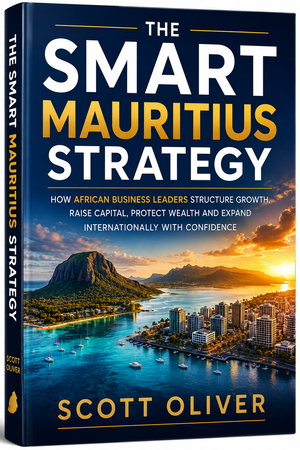
Free Chapter
The SMART Mauritius Strategy
Discover how African business leaders use smarter structures to raise capital, protect wealth and expand internationally.
Download NowBanking Redundancy Is Not a Luxury
Ask people why they went offshore and many will talk first about tax. Ask them what actually hurt when things went wrong, and the answer is often banking.
A blocked transfer, a delayed compliance review, a sudden loss of account access, a problem proving source of funds across borders, a domestic banking system under stress, these are the events that turn theory into pain. Tax planning does not solve that. Banking redundancy does.
Mauritius has long had a financial-services ecosystem built around cross-border activity. It is a jurisdiction where multi-currency banking, international structuring, and offshore-to-onshore interaction are part of the normal landscape. Just as important, Mauritius has no exchange controls in the conventional sense that many investors fear. The Foreign Exchange Control Act was suspended in 1994, and current guidance reflects that approval is not generally required for the repatriation of profits, dividends, or capital gains. That is not simply a technical benefit. It speaks directly to freedom of movement.
This is where Mauritius starts to look less like a tax story and more like a control story. It can operate as another rail, another place through which capital can move, another platform from which a company, an investment holding structure, or a family office can function.
In an unstable world, that extra rail matters. The wealthiest and most resilient people do not merely look for return on capital. They look for continuity of access. A second banking and financial base can be worth more than a marginally lower tax result in a jurisdiction that proves awkward or fragile when pressure arrives.

Jurisdictional Optionality Has Become a Form of Insurance
A generation ago, many people still assumed that one well-run home country was enough. They might invest internationally, but they would continue to live, bank, hold, and plan from one jurisdiction, trusting that the future would remain broadly stable. That assumption has weakened. Politics has grown harsher. Compliance has tightened. Tax authorities have become more aggressive. Banks have become less forgiving.
The idea that a sophisticated person should have only one residence option, one legal base, one banking center, and one plan for the future now looks less prudent than it once did.
Mauritius addresses that need for optionality in a practical way. Official routes exist for investors, professionals, and the self-employed through the Occupation Permit framework.
Residence can also be linked to approved real-estate acquisition above the familiar threshold of USD$375,000. For retirees, Mauritius offers a residence path for non-citizens aged 50 and above, subject to required transfers into the country. None of these routes will suit everyone. That is not the point. The point is that the options exist, and options are strategic assets.
This is why the discussion around Mauritius should not be reduced to lifestyle brochures or residency sales language. The country's value lies in the way residence, banking, legal structure, and tax efficiency can work together.
Even if an investor never moves full time, the existence of another legitimate base changes the strategic picture. It gives families room to think. It gives entrepreneurs another place from which to organize expansion.
It gives retirees and internationally mobile professionals a stable fallback. Most of all, it reduces dependency on the assumption that one government, one banking system, and one national trajectory will always remain favorable.
Tax Matters, but It Is Not the Foundation
Tax still matters, of course. It would be foolish to pretend otherwise. Mauritius remains attractive because the tax side of the equation is genuinely competitive.
The standard corporate rate is 15 percent. There is no general capital gains tax in the classic sense. Dividends paid to non-residents are generally exempt under current guidance. The treaty network is substantial, with 45 agreements in force according to the Mauritius Revenue Authority. For the right structures and the right facts, these features can make a real difference to net outcomes.
But this is exactly where many offshore narratives become distorted. They treat tax as the reason to build, when in fact tax should be the reward for building on a sound base.
A weak structure in the wrong jurisdiction does not become wise simply because the spreadsheet looks attractive. If legal enforceability is poor, if banking access is awkward, if the jurisdiction is hard to explain to institutional counterparties, or if residence and long-term optionality remain missing, then a lower tax rate may be little more than decorative sophistication.
Mauritius wins because it does not ask the investor to choose between respectability and efficiency. It sits in a valuable middle ground. It is not the Cayman Islands, and for many serious investors that is a strength rather than a weakness. It is not trying to vanish into secrecy.
At the same time, it is not a high-tax Western bureaucracy slowly becoming more extractive while offering fewer strategic advantages in return. Mauritius is compliant, visible, connected, and still flexible enough to be useful. That combination is rarer than many people realize.

Why Mauritius Makes Sense for a Certain Kind of Investor
The best fit is not everyone. A person looking for a fantasy island and zero obligations may be disappointed. A person looking only for a simplistic tax gimmick is probably focusing on the wrong thing from the start.
Mauritius is more suitable for internationally minded investors who want a credible second base, for African entrepreneurs who need a respected bridge jurisdiction, for families thinking about preservation across generations, and for globally mobile professionals or retirees who value long-term optionality over aggressive posturing.
It also helps that Mauritius has cultivated a reputation that is difficult to reduce to a slogan. The Global Forum on Transparency and Exchange of Information for Tax Purposes has rated Mauritius “Compliant,” which matters in a world where reputational credibility affects everything from banking relationships to how structures are perceived by outside professionals. That does not mean every strategy built through Mauritius is wise. It does mean the jurisdiction itself is not operating in the shadows. For many serious clients, that is precisely the attraction.
The practical appeal is easy to miss if one looks only at tax. Mauritius sits at a strategic point between Africa, Asia, and Europe. It operates in a time zone that works surprisingly well for cross-border business. It offers political and institutional stability that is meaningful in an African context. It has developed professional services around global business, trusts, funds, fiduciary administration, and cross-border holding structures.
None of these qualities are as dramatic as a headline tax claim. Together, they are far more valuable.

The Bottom Line Is Control
In the end, the offshore conversation needs a more honest vocabulary. The point is not escape. The point is not secrecy. The point is not some adolescent thrill about “beating the system.”
Mature investors think differently. They understand that offshore planning, at its best, is a method of reducing dependency. It is a way of protecting wealth from unnecessary concentration, building access across more than one banking and legal environment, and creating room to adapt when the world changes faster than expected.
Mauritius is powerful because it speaks to that deeper need. It offers legal familiarity without being stale, financial connectivity without being chaotic, residence optionality without requiring every investor to become an expatriate overnight, and tax efficiency without forcing people into a structure that looks unserious to banks and advisers. It is not magic. It is not the answer for everyone.
But for the right investor, it solves a more important problem than tax alone ever could.
That is why smart investors do not go offshore simply to pay less. They go offshore to gain control, over structures, over banking access, over jurisdictional exposure, and over the range of choices available to them and their families.
Mauritius deserves attention because it helps deliver that control in a form that is calm, credible, and strategically useful. In a more uncertain world, that may be the most valuable offshore advantage of all.
Scott Oliver is a retired British writer and independent researcher living in Mauritius. A former Royal Marines Commando and former Wall Street investment professional, he has spent more than four decades living and working internationally across 14 countries. During that time, he worked extensively in international wealth management, cross-border asset protection, international business structuring and global residency planning.
Today, Scott's focus is no longer on managing money or providing professional advice. Instead, through MauritiusWealth.mu, he writes independent educational articles designed to help successful African business owners ask better questions, make better decisions and, when appropriate, identify the right expertise to help protect everything they have spent a lifetime building.
His articles are published solely for general educational and informational purposes and should not be regarded as legal, financial, tax, immigration, investment or other professional advice. Every business owner's circumstances are unique, and readers requiring professional assistance should always consult an appropriately qualified and licensed professional.