
The Mauritius Stress Test: What Happens If $150 Oil Becomes the New Normal?
An investigation into how a prolonged global energy crisis could affect the Mauritian rupee, electricity, food prices, inflation, tourism, and the business and retirement case for Mauritius.
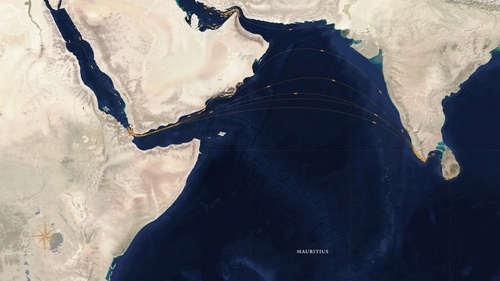
On a map, Mauritius looks safely removed from the turmoil of the Middle East.
There are no missiles flying over Port Louis. Mauritius produces no oil. It is thousands of kilometres from the Strait of Hormuz, the Persian Gulf and the increasingly dangerous waters around Yemen.
Economically, however, Mauritius may be much closer to the Middle East than the map suggests.
That is because Mauritius is a small island economy that depends heavily on the outside world for its energy, food, manufactured goods and raw materials. When the global system works normally, that dependence is easily overlooked.
When oil prices surge and major shipping routes become dangerous, the vulnerability becomes much easier to see.
According to Statistics Mauritius, imported fuels supplied 90.8% of Mauritius's total primary energy requirement in 2025. Petroleum products alone accounted for 64.3%, while coal accounted for another 26.4%.
So what happens if today's Middle East crisis continues to deteriorate?
More importantly, what happens if oil does not merely spike for a few days, but eventually reaches $150 a barrel and remains extremely expensive for months?
For African business leaders considering Mauritius as a base for international structuring, and for South Africans, Britons, Americans and others considering the island for retirement, it is a question worth examining carefully.

The Crisis Is No Longer Theoretical
By September 2026, the global energy situation had already become extraordinary.
Before the Iran war began in February, approximately 125 large commercial vessels passed through the Strait of Hormuz each day, according to shipping data reported by Reuters. On September 10, only seven vessels were recorded transiting the strait.
Hormuz normally handles roughly one fifth of the world's daily crude oil and liquefied natural gas supplies.
At the same time, Iran aligned Houthi forces seized the Yemeni port city of Mocha and advanced toward strategically important positions around the Bab el Mandeb Strait, another critical artery connecting the Indian Ocean with the Red Sea and Suez Canal.
Saudi Arabia has another option. Its East West Pipeline can transport crude from the oil producing east of the country to Yanbu on the Red Sea, bypassing Hormuz.
But even that alternative has come under threat. Reuters reported smoke near the pipeline in September as attacks on Saudi energy infrastructure intensified.
The consequences are already visible in energy markets. Brent crude closed above $107 a barrel on September 10 before falling back to around $104 the following day. The International Energy Agency reported that Saudi crude supply had fallen to approximately 6 million barrels per day in August, its lowest level in more than three decades.
This does not mean oil will reach $150.
But it makes asking what would happen if it did considerably less theoretical than it once appeared.
Mauritius's Hidden Energy Dependency
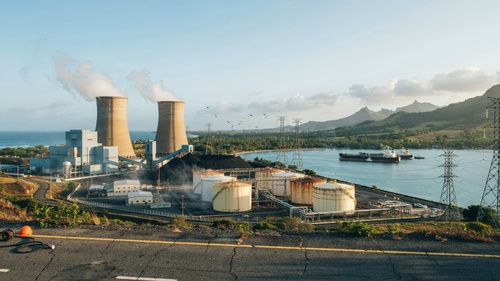
To understand the risk, we first looked at how Mauritius actually produces its electricity.
The answer is revealing.
In 2025, Mauritius generated 3,551.6 gigawatt hours of electricity. Approximately 49.6% came from diesel and fuel oil. Coal supplied another 31.4%.
Renewable energy supplied only 17.8%.
Within that renewable share were bagasse and fuelwood, solar photovoltaic generation, hydroelectric power, wind and landfill gas.
This means approximately 82.2% of Mauritius's electricity was generated from non renewable sources in 2025.
More importantly for the present crisis, electricity generation from diesel and fuel oil actually increased by 21.3% between 2024 and 2025, from 1,451 GWh to 1,761 GWh. Coal generation fell by 16.4% over the same period.
Solar is expanding rapidly. Photovoltaic generation increased almost 30% in 2025. But solar still supplied only about 6.5% of total electricity generation.
So Mauritius remains highly dependent on imported fossil energy.
This matters because an oil shock can reach the Mauritian economy through far more than the petrol station.
Follow The Oil
Imagine oil eventually reaches $150 a barrel and stays there.
The first effect is obvious. Mauritius pays more for petroleum.
We already have evidence of how quickly that can happen. In April 2026, Prime Minister Navin Ramgoolam said Brent crude had risen from $72.48 to $111 a barrel. Mauritius's petroleum import bill had consequently increased by an extraordinary 82% in March.
But petroleum is only the beginning.
Higher energy costs affect electricity generation, road transport, buses, taxis, fishing boats, construction equipment, hotels, restaurants, airlines and almost every company moving physical goods around the island.
Then there is shipping.
Mauritius is approximately 2,000 kilometres from the African mainland. Almost everything heavy that the country imports must cross an ocean.
Ships consume fuel. Longer voyages consume more fuel. Dangerous shipping routes increase insurance costs. Disrupted shipping schedules tie up vessels for longer. All of those costs eventually have to be paid by someone.
For an import dependent island, expensive energy has a habit of appearing almost everywhere.
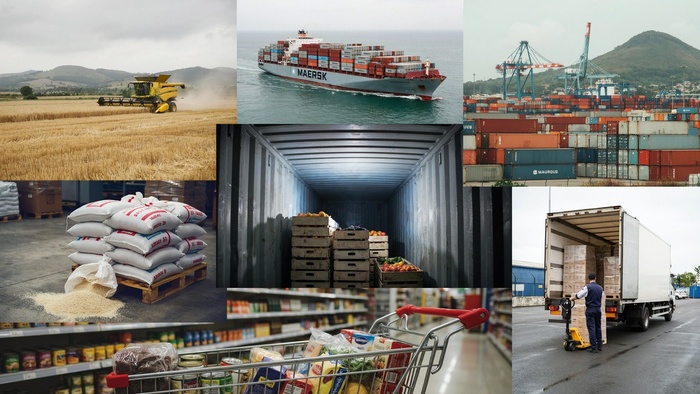
How $150 Oil Reaches Your Supermarket Trolley
Consider something as ordinary as an imported food product sitting on a supermarket shelf in Grand Baie, Tamarin or Port Louis.
Its exposure to energy may have begun thousands of kilometres away.
The farmer may have used nitrogen fertilizer produced using enormous amounts of energy. Tractors required diesel. Irrigation pumps required power. Harvesting machinery required fuel. The product may then have been processed, refrigerated, packaged and transported to a port.
It crossed an ocean aboard a ship. It arrived at Port Louis. A diesel powered truck moved it to a warehouse. Refrigeration may have continued. Another vehicle eventually delivered it to the supermarket.
Energy is embedded throughout the chain.
And food imports are already moving sharply in Mauritius. Statistics Mauritius reported that imports of food and live animals increased 14.1% in value in the first quarter of 2026 compared with the same quarter of 2025.
There is another danger that takes longer to arrive.
Fertilizer.
The World Bank reported in April 2026 that fertilizer prices were projected to increase 31% during 2026, with urea prices expected to rise around 60%. The Bank noted that a geopolitically driven 10% oil price increase can eventually produce a fertilizer price increase of more than 5%, with the effect potentially peaking around a year after the original oil shock.
Natural gas can account for 80% to 90% of the production cost of ammonia, the principal feedstock for urea.
If fertilizer becomes too expensive, farmers do not simply complain about the price. Some apply less of it, change crops or reduce planting.
That can eventually affect yields.
This is why a prolonged energy crisis can produce two separate food shocks. The first comes through transport, production and freight. The second can arrive months later through fertilizer costs and agricultural production.
The Rupee Could Become The Multiplier
There is another mechanism that could make the problem considerably more serious.
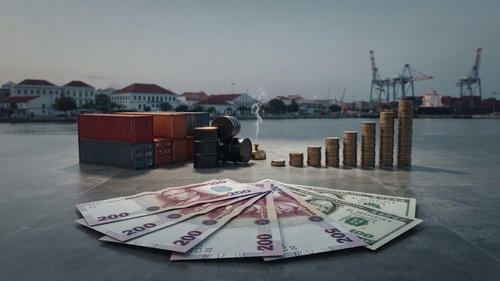
Mauritius buys much of what it needs from the rest of the world. Those purchases ultimately create demand for foreign currency.
When oil becomes dramatically more expensive, Mauritius needs more foreign currency to purchase the same quantity of energy.
That matters to the balance of payments and potentially to the Mauritian rupee.
During the first six months of 2026, Mauritius recorded a visible trade deficit of approximately Rs113.1 billion, already 12.5% larger than during the equivalent period in 2025.
In the second quarter alone, imports of mineral fuels, lubricants and related materials increased an extraordinary 71.5% compared with the same quarter of 2025.
The Bank of Mauritius reported that between January and July 2026 the rupee depreciated 1.3% against the US dollar. On September 10, indicative bank rates published by the Bank of Mauritius showed approximately Rs46.14 on the buying side and Rs47.52 on the selling side for one US dollar.
That is not a currency crisis.
But consider what happens if an external shock causes international prices and the exchange rate to move against Mauritius simultaneously.
Suppose an imported product previously cost $100 and the exchange rate was Rs46 to the dollar. Its underlying rupee cost would be Rs4,600.
Now suppose the international cost rises 15%, to $115, while the rupee simultaneously depreciates 10%, to approximately Rs50.60 to the dollar.
The same product now costs about Rs5,819 before considering any additional domestic costs.
That represents an increase of roughly 26.5%.
This is the multiplier effect that matters to an import dependent island.
The global price can rise, while simultaneously the currency used to buy it becomes more expensive.
Mauritius Is Already Experiencing Inflation
The official numbers show that the cost pressures have already begun.
Statistics Mauritius reported year on year inflation of 4.9% in August 2026.
Between March and June alone, the Consumer Price Index increased 2.4%.
The contributors tell the story better than the headline number. Higher prices were recorded for bread, cooking oil, electricity, cooking gas, gasoline, diesel, international airline tickets, taxi fares and prepared foods.
The Bank of Mauritius is watching the same problem.
At its May 2026 Monetary Policy Committee meeting, the Bank modelled a baseline scenario that assumed average oil of only $90 per barrel, resolution of the Middle East conflict and full reopening of the Strait of Hormuz by the end of the first half of the year.
Even under those assumptions, it projected 2026 inflation of approximately 5.5%, sharply higher than its previous forecast of 3.6%.
The Bank later reduced its 2026 projection to around 5%, partly because of government subsidies on selected staple foods and lower realised inflation.
But the warning remained.
The Bank said the risks to inflation were still firmly tilted upward. It specifically identified renewed geopolitical escalation, higher global oil and food prices, disruption to maritime routes, elevated freight and insurance costs, and exchange rate pressure.
It also warned that the existing fuel pricing mechanism has limited capacity to absorb further increases in international oil prices.

The $150 Mauritius Stress Test
So what would $150 oil actually mean?
No serious analyst can say that $150 oil automatically produces a particular inflation rate in Mauritius. Too many variables are involved.
The duration matters. The rupee matters. Government subsidies matter. Freight rates matter. Electricity tariffs matter. Fertilizer matters. Shipping security matters. Global food production matters.
Most importantly, there is an enormous difference between oil touching $150 for three days and averaging $150 for nine months.
But we can stress test the economy.
If oil remained around $100 to $120, Mauritius would probably experience continued inflationary pressure, but existing buffers, foreign exchange reserves, government intervention and monetary policy could help contain the damage.
A sustained $150 environment would be different.
It could push simultaneously on fuel, electricity generation, food, freight, airfares, tourism, construction, business operating costs and the trade deficit.
If the rupee also weakened significantly, the pressure would multiply.
Under a scenario involving $150 oil for six to twelve months, prolonged shipping disruption and continued pressure on imported commodities, an inflation rate somewhere in the region of 7% to 10% would not be difficult to imagine.
That is not an official Bank of Mauritius forecast. It is a stress test based on the channels through which an extreme energy shock could enter the Mauritian economy.
In a more severe scenario involving substantial rupee depreciation, persistent shipping disruption and continuing increases in international food and fertilizer prices, double digit inflation becomes a risk that should not simply be dismissed.
The Currency You Earn Could Matter More Than The Country You Came From
There is an important complication for anyone considering retiring or doing business in Mauritius.
Not everybody experiences Mauritian inflation in the same way.
Consider first a Mauritian professional whose salary and savings are entirely in rupees.
If food, electricity and transport increase 8%, while the employee's salary increases only 3%, that person suffers a real reduction in purchasing power. If the rupee also weakens, imported products become more expensive without providing any compensating increase in income.
Now consider a retired South African living in Mauritius and receiving retirement income from South Africa.
The outcome depends heavily on what happens between the rand and the Mauritian rupee. Both currencies may weaken against the dollar during an international crisis. What ultimately matters to that retiree is how much Mauritian purchasing power each rand of retirement income provides.
A British retiree presents a different case.
Someone receiving a UK pension or investment income in pounds may have a partial natural hedge. If the Mauritian rupee depreciates against sterling, every pound produces more rupees, offsetting some of the increase in local prices.
Imagine a British couple receiving £4,000 every month. Their real question is not simply whether Mauritius inflation is 5%, 8% or 10%. Their question is how much food, electricity, housing, transport and leisure their £4,000 can purchase after exchange rates have adjusted.
The same principle applies to an American retiree receiving dollars.
In the particular scenario being examined here, US dollar income could provide an especially useful hedge. Oil and many internationally traded commodities are priced in dollars. If an energy crisis puts downward pressure on the Mauritian rupee while the retiree continues receiving dollar income, every dollar converts into more rupees.
That does not make the American retiree immune. Imported goods themselves may become more expensive in dollar terms. Airfares can rise. Food commodities can rise. Insurance and freight can rise.
But the American is in a fundamentally different position from someone receiving a fixed income entirely in Mauritian rupees.
The same distinction matters enormously to business owners.
An African entrepreneur earning revenue internationally in dollars, euros or pounds while maintaining a Mauritius base may experience the crisis very differently from a Mauritian company importing physical products in dollars and selling them locally in rupees.
The latter can be squeezed from both sides. Its import costs rise while its domestic customers become less able to absorb price increases.
For internationally oriented entrepreneurs, the lesson is simple. Your exposure is determined not merely by where you live or where your company is incorporated, but by the currencies in which you earn, spend, borrow and hold assets.
Could Mauritius Actually Run Out Of Fuel Or Food?
This is where an investigation needs to distinguish between an expensive crisis and a genuine supply crisis.
There are reasons not to panic.
Mauritius had gross official international reserves of approximately $9.7 billion at the end of July 2026. The Bank of Mauritius calculated this as equivalent to about ten months of imports using its broader measure.
That represents a meaningful financial buffer.
There has also been an important development in physical energy security.
Mauritius and India recently strengthened their energy partnership through an agreement involving the State Trading Corporation and Indian Oil Corporation.
The Mauritian Government says the arrangement provides a five year supply commitment covering Mauritius's entire requirement for white oil petroleum products.
That is strategically significant.
It does not guarantee cheap oil. India itself operates in the global energy market and cannot repeal the world oil price.
But there is an enormous difference between paying substantially more for fuel and being unable to obtain fuel at all.
For Mauritius, the more credible immediate danger therefore appears to be price rather than physical availability.
The same distinction applies to food. A severe international crisis could make imported food substantially more expensive. Specific products could become temporarily difficult to obtain. Supply chains could become erratic.
But predicting widespread food shortages or starvation in Mauritius would go far beyond the evidence presently available.
The more realistic threat is a prolonged erosion of purchasing power.
Mauritius Is Not Sitting Still
The Government clearly understands the vulnerability.
After the initial energy shock earlier in 2026, it established an Inter Ministerial Crisis Committee and announced measures to strengthen fuel reserves, optimise energy production, accelerate renewable energy projects and improve energy conservation.
The Government said renewable projects expected over the coming years could add approximately 405 MW of generating capacity.
That transition matters.
Every additional unit of electricity produced locally from solar, wind, hydro or other renewable sources reduces some exposure to imported fossil fuels.
But changing the energy structure of an entire country takes years, not months.
Mauritius therefore enters the present crisis with real defences, but also with substantial structural dependence on imported energy.
Tourism Could Feel The Shock Too
There is another vulnerability that should matter to business leaders examining the Mauritian economy.
Tourism is one of Mauritius's most important sources of foreign currency.
But Mauritius is a long haul destination for many of its most valuable visitors.
Aircraft require enormous quantities of jet fuel.
If oil remains exceptionally expensive, airlines eventually have to absorb the additional cost, reduce routes or pass more of that cost to passengers.
A European family deciding between a holiday requiring a long haul flight to Mauritius and a much shorter Mediterranean trip may become more price sensitive.
That creates another potential feedback mechanism.
Mauritius needs foreign currency to pay for imports. Tourism helps provide that foreign currency. If extremely expensive aviation simultaneously damages tourism while increasing the country's import bill, pressure can develop on both sides of the external account.
Again, this does not mean tourism collapses at $150 oil.
It means tourism becomes another part of the stress test.
Should Business Leaders Be Worried About Mauritius?
That is probably the wrong question.
The more intelligent question is, how does Mauritius compare with the alternatives under exactly the same global shock?
Dubai is hardly isolated from a crisis involving the Persian Gulf and Strait of Hormuz.
Singapore is one of the world's great international business centres, but it too is extraordinarily dependent on imported energy and international trade.
Europe has its own exposure to energy costs, geopolitical conflict and natural gas.
South Africa has substantial domestic resources, but also faces its own electricity, infrastructure, currency and political risks.
No serious international jurisdiction should be evaluated in isolation.
The relevant exercise is comparative risk.
Mauritius continues to possess advantages that an oil price cannot erase. It has political stability, established financial institutions, an international financial centre, strong links with India, access to African markets, an extensive network of international agreements, a functioning legal system, a substantial tourism industry and meaningful foreign exchange reserves.
But stability does not mean immunity.
A sophisticated business owner should want to understand both sides of the balance sheet.
And What About Retirement?
The same principle applies to someone considering spending the next ten or twenty years in Mauritius.
Does $150 oil destroy the Mauritius retirement proposition?
No.
But it could change the economics.
A retiree considering Mauritius should understand the island's dependence on imported energy and food, the potential effect of international oil prices on electricity and transport, the importance of exchange rates, and the possibility that international air travel becomes considerably more expensive.
For someone receiving retirement income in US dollars, pounds or another strong foreign currency, the effect may be partially cushioned by exchange rate movements.
For someone whose retirement income is denominated in a weaker currency, the calculation may be very different.
That is not an argument against retiring in Mauritius.
It is an argument for understanding the financial mechanics before doing so.
The Biggest Risk May Not Be $150 Oil
There is a larger lesson hidden inside this crisis.
The real vulnerability is not that oil might reach $150 next Tuesday.
It is that Mauritius, like much of the modern global economy, developed during an era in which international energy supplies, shipping routes and global supply chains were generally assumed to remain available and reasonably reliable.
The events around Hormuz, Saudi Arabia and Bab el Mandeb are stress testing that assumption.
The World Bank has already warned that the poorest households and import dependent developing economies are likely to suffer disproportionately from the present energy shock. It has also warned that higher energy prices can migrate into fertilizer, food and broader inflation long after the original oil price increase.
Mauritius cannot control the Strait of Hormuz.
It cannot control the global oil price.
It cannot control the cost of fertilizer produced thousands of kilometres away.
What it can control is how resilient it becomes.
That means diversifying energy, increasing local renewable generation, maintaining adequate reserves, protecting access to strategic suppliers, strengthening food security, managing public finances carefully and preserving confidence in the Mauritian rupee.

The Bottom Line
Mauritius is not facing an economic catastrophe today.
Inflation was 4.9% year on year in August 2026. The rupee has weakened modestly against the dollar. Foreign exchange reserves remain substantial. The country has strengthened its petroleum supply relationship with India. Its financial system remains functional and its major service industries continue to provide foreign currency.
But the warning lights are visible.
More than 90% of Mauritius's primary energy requirement is imported. More than 80% of its electricity is still generated from non renewable sources. Almost half of its electricity was generated from diesel and fuel oil in 2025. The first half 2026 trade deficit reached approximately Rs113.1 billion. Fuel imports have already surged, and the Bank of Mauritius says the risks to inflation remain firmly tilted upward.
If oil briefly reaches $150, Mauritius can probably absorb the shock.
If oil remains above $150 for many months while Hormuz and Bab el Mandeb remain disrupted, freight and fertilizer stay expensive, and the Mauritian rupee comes under additional pressure, the consequences become much more serious.
Electricity becomes more expensive to produce. Imported food becomes more expensive to grow, manufacture and transport. Businesses face higher operating costs. Airlines face higher fuel bills. Households lose purchasing power. The trade deficit can deteriorate. Currency pressure can make imports still more expensive.
The result could become a self reinforcing inflationary cycle.
That does not make Mauritius a bad place to do business, structure international affairs or retire.
It makes proper due diligence more important.
Anyone considering moving their business, wealth or life to Mauritius deserves to understand not only what makes the country attractive, but also where the island is vulnerable.
That is particularly important during a period when assumptions that seemed permanent only a few years ago, cheap energy, secure shipping lanes and predictable global supply chains, suddenly look considerably less certain.
The real Mauritius stress test is therefore not whether the island can survive $150 oil. It can. The more important question is what happens to the cost of living, the currency, business profitability and household purchasing power if expensive energy becomes the new normal rather than a temporary crisis.
Scott Oliver is a retired British writer and independent researcher living in Mauritius. A former Royal Marines Commando and former Wall Street investment professional, he has spent more than four decades living and working internationally across 14 countries. During that time, he worked extensively in international wealth management, cross-border asset protection, international business structuring and global residency planning.
Today, Scott's focus is no longer on managing money or providing professional advice. Instead, through MauritiusWealth.mu, he writes independent educational articles designed to help successful African business owners ask better questions, make better decisions and, when appropriate, identify the right expertise to help protect everything they have spent a lifetime building.
His articles are published solely for general educational and informational purposes and should not be regarded as legal, financial, tax, immigration, investment or other professional advice. Every business owner's circumstances are unique, and readers requiring professional assistance should always consult an appropriately qualified and licensed professional.
Expert Resources Used By The Author To Research and Write This Article.
- Statistics Mauritius: Energy and Water Statistics 2025
Official data covering Mauritius's imported energy dependence, electricity generation, petroleum products, coal and renewable energy. Read the official statistics. - Statistics Mauritius: Consumer Price Index
Official inflation data showing changes in the cost of food, electricity, fuel, transport and other household expenses. Read the CPI report. - Statistics Mauritius: External Trade Statistics
Official figures covering Mauritius's imports, fuel costs and widening visible trade deficit during 2026. Read the trade statistics. - Bank of Mauritius: Monetary Policy Committee
The Bank's assessment of inflation, the rupee, foreign exchange reserves, oil prices, shipping disruption and the economic risks created by the Middle East conflict. Read the Bank's assessment. - Government of Mauritius: Energy Security Partnership With India
Official information on the Mauritius and India energy agreement and the five year Indian Oil Corporation supply commitment covering Mauritius's petroleum requirements. Read the Government announcement. - World Bank: Commodity Markets Outlook 2026
Analysis of the Middle East energy shock and its potential effects on oil, natural gas, fertilizer, food security and inflation in developing economies. Read the World Bank analysis.