

The African Business Chessboard: How Smart Business Leaders Use Mauritius to Change the Game
African CFOs are not operating on a simple business map. They are operating on a continental chessboard where currencies, regulations, banking corridors and global perceptions act as living pieces that move in unpredictable ways.
Every decision in one market can trigger a sequence of reactions in several others. A tightening of currency controls in one country alters the movement of capital in a second. A compliance review in a partner bank affects the timing of payments across the region. Even a small adjustment in regulatory language can create a ripple that extends far beyond its borders.
Executives who have played this game long enough understand that the real threat is rarely a competitor. The real threat is mispositioning. When an organisation occupies the wrong square, even strong operations and strong financial management cannot overcome the friction created by the board itself.
This is why many African firms experience slower payments, heavier compliance burdens, inconsistent tax treatment and reduced investor confidence even when their commercial fundamentals are solid.
The companies that rise above this pattern do something different. They reposition themselves on a square that changes how the entire board behaves.
Mauritius has become that square because it provides African CFOs with a neutral base where taxation becomes clearer, banking becomes more predictable, currency risk stabilises and global stakeholders view the organisation as credible and well governed. It functions like a central position in chess that grants the player more control with fewer moves.
African growth is accelerating. The winners will be the companies that place themselves where the board works for them rather than against them. Mauritius is the square that allows this to happen.
Free Chapter
The SMART Mauritius Strategy
Discover how African business leaders use smarter structures to raise capital, protect wealth and expand internationally.
Download NowSeeing the Board for What It Really Is
Most companies still approach Africa as if each country is an isolated market. CFOs who succeed at scale understand that the region behaves like an interconnected system. Currency decisions in one jurisdiction can influence investor behaviour in another. Banking friction in a single market can delay payments across the entire organisation. A change in withholding tax rules in one country may affect the profitability of the group as a whole.
Once you understand this interdependence, the conclusion becomes clear. Strategy is not only about growth plans or operational efficiency. The location of the organisation on the chessboard matters just as much. The origin of operations shapes how regulators treat you, how global banks respond and how investors evaluate risk.

The Hidden Friction African CFOs Face
Some of the most significant barriers to scale do not appear as visible line items in a financial statement. They build up slowly and silently. Over time they create drag that reduces competitiveness even in companies with strong products and strong execution. CFOs encounter a recurring set of friction points.
- Payment delays created by compliance checks when banks see an African origin of funds.
- Higher withholding taxes caused by gaps or weaknesses in treaty protection.
- Currency losses when revenue is trapped in depreciating local currencies.
- Investor hesitation when the holding structure is located in a jurisdiction perceived as high risk.
- Administrative complexity caused by inconsistent rules across multiple African markets.
These issues rarely appear all at once. Instead they accumulate quietly and erode performance over time. The businesses that outgrow these problems do so by acknowledging that the root challenge is structural. It cannot be solved by local fixes alone. It requires repositioning the organisation on the right square.

Changing the Board with Mauritius
Mauritius has become the preferred jurisdiction for African companies that want to reduce friction and create a stable base for regional operations. Its international reputation, legal framework and treaty network provide CFOs with tools that directly address the most persistent barriers to cross-border growth.
Several characteristics of Mauritius create a meaningful advantage for African businesses.
- An extensive network of more than forty signed Double Taxation Agreements that reduce uncertainty and prevent duplicate taxation.
- A legal system rooted in English Common Law that supports predictable decision making and appeals to global investors.
- Access to respected international banks that offer clean USD and EUR payment corridors with fewer compliance delays.
- A recognised reputation as an international financial centre that global stakeholders understand and trust.
- Governance standards that meet the expectations of multinational partners.
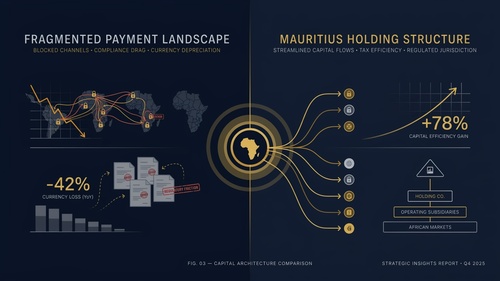
The value of Mauritius is not only technical. It is strategic. When a company positions itself in a neutral and well governed jurisdiction, the board begins to behave differently. Payments clear faster. Partnerships become easier to negotiate. Investors assign lower risk premiums. Currency volatility becomes easier to manage. This shift opens the door to expansion that is smoother and more predictable.
The Strategic Advantage of Positioning
CFOs often describe the move to Mauritius as the moment when clarity enters the picture. The advantage is not secrecy or avoidance. It is the ability to operate from a position where the rules are clear and where global stakeholders recognise the organisation as professionally managed.
Mauritius offers four advantages that directly affect financial performance.
- Predictable cross-border taxation. The treaty network provides clarity on withholding taxes, profit allocation and permanent establishment rules.
- More reliable international payments. Mauritian banking reduces compliance friction and shortens settlement time.
- Stronger investor confidence. A Mauritius holding structure signals governance maturity and reduces perceived country risk.
- Centralised treasury capacity. Consolidating USD and EUR flows in Mauritius improves visibility and reduces currency losses.
This is the equivalent of claiming a central square on the chessboard. From that position every future move becomes more efficient.
A Framework for CFOs Evaluating Mauritius
Successful CFOs follow a structured process when assessing whether Mauritius is the right square for their organisation. The process focuses on identifying friction points and evaluating whether a centralised structure can resolve them.
- Identify where friction arises in invoicing, taxation, compliance and currency management.
- Determine whether these challenges originate from the current country of incorporation.
- Assess the organisation's expected cross-border activity over the coming years.
- Model scenarios in which the holding company and treasury centre operate from Mauritius.
- Confirm that the organisation is able to meet Mauritius substance and governance requirements.
The goal is precision. Mauritius provides value when it strengthens operational performance, improves financial stability and enhances long-term credibility.

When Organisations Do Not Make the Move
Remaining fully anchored in a single African jurisdiction creates a long-term opportunity cost. Payments take longer. Margins weaken. Compliance scrutiny becomes heavier. Investors hesitate. Expansion into new markets requires more effort and more capital. These effects compound over time.
CFOs who reposition through Mauritius often report a distinct shift in performance. Payments accelerate. Treasury gains better oversight. International suppliers respond with more confidence. The organisation begins to scale with less resistance and more predictability.

Bottom Line for Decision Makers
African business is a chessboard and position determines performance. The companies that succeed over the next decade will be those that place themselves on a square that reduces friction and improves control.
Mauritius offers clarity, stability and international credibility. It is the position that allows African CFOs to turn complexity into strategic advantage and to grow across markets with confidence.
Scott Oliver is a retired British writer and independent researcher living in Mauritius. A former Royal Marines Commando and former Wall Street investment professional, he has spent more than four decades living and working internationally across 14 countries. During that time, he worked extensively in international wealth management, cross-border asset protection, international business structuring and global residency planning.
Today, Scott's focus is no longer on managing money or providing professional advice. Instead, through MauritiusWealth.mu, he writes independent educational articles designed to help successful African business owners ask better questions, make better decisions and, when appropriate, identify the right expertise to help protect everything they have spent a lifetime building.
His articles are published solely for general educational and informational purposes and should not be regarded as legal, financial, tax, immigration, investment or other professional advice. Every business owner's circumstances are unique, and readers requiring professional assistance should always consult an appropriately qualified and licensed professional.
Expert Resources
- Mauritius Revenue Authority Overview of Tax Treaties
Reference guide to current Double Taxation Agreements and treaty coverage.
Read the report - Economic Development Board Treaty and Investment Agreements
Official summary of bilateral agreements and investment protections available to businesses.
Read the report - African Venture Capital Association Review of Mauritius as an IFC
Analysis of why Mauritius is a preferred jurisdiction for Africa facing investment structures.
Read the report - Hogan Lovells Analysis of Mauritius Governance Standards
Legal insight into the transparency and substance requirements that underpin the Mauritius financial system.
Read the report - IFC Review Profile of Mauritius as a Financial Centre
Independent review of Mauritius as a trusted and stable IFC for cross-border business flows.
Read the report - Lex Africa Commentary on Treaty Landscape
Regional perspective on treaty evolution and what organisations should consider when structuring through Mauritius.
Read the report