
Africa–China Trade Is Changing Quietly and Most CEOs Haven't Adjusted Yet
Across Africa, something important is changing in the way business with China is being settled, financed, and structured. There has been no dramatic announcement. No single event that forces attention. Yet the shift is already underway, and many CEOs are still managing their companies as if nothing has changed.

Nothing Dramatic Has Happened. That Is the Problem.
There has been no major headline. No sudden break with the past. No moment that makes executives stop and say, “This changes everything.”
And yet, across the continent, the mechanics of Africa–China trade are slowly evolving. Payments are being settled differently. Contracts are being structured differently. Financing relationships are becoming more complex. In some cases, even official payments are beginning to move in currencies other than the US dollar.
The shift is quiet. Which is exactly why most CEOs have not adjusted.
The Change Is Operational, Not Political.
This is not primarily a political story. It is a business story.
Across several African economies, companies are increasingly dealing with China in ways that do not always run neatly through the dollar.
Suppliers may request settlement in yuan. Infrastructure contracts may be linked to Chinese financing structures. Debt servicing may involve Chinese institutions. In some markets, governments are showing greater willingness to accommodate these realities.
None of this means the dollar has disappeared. It has not. But it does mean that the actual flow of money is becoming more complex than many executives assume.
And when money moves differently, margins, risk, and control move with it.

Most Businesses Still Think They Are Operating in Dollars.
Ask many African CEOs what currency their business operates in, and the answer will often come quickly: dollars.
But look more closely at the transaction chain. Revenue may be received in dollars. Suppliers may need to be paid in yuan. Equipment may be sourced through Chinese contractors. Debt may be serviced in a mix of currencies. Banking relationships may involve multiple jurisdictions. The visible currency is often only part of the story.
What looks like a dollar-based business can in reality be a multi-currency business that is simply not being managed as one.
That distinction matters more than most executives realise.
Where Value Is Quietly Being Lost.
When currency flows are not aligned, inefficiencies build up quietly.
One unnecessary conversion here. A small pricing mismatch there. A treasury decision made reactively rather than structurally. A financing arrangement that no longer fits the underlying flow of the business.
On their own, these issues may seem minor. Together, they create friction that compounds over time.
This is how value is often lost in cross-border business. Not through one dramatic mistake, but through repeated operational leakage that no one has properly mapped or challenged.
The problem is not simply volatility. The deeper problem is lack of control.

This Is Not a Treasury Issue. It Is a Strategy Issue.
Many businesses still treat currency management as a back-office function. That made sense in a world where most international trade moved through a single dominant currency and where the structure of a transaction was relatively predictable.
That world is becoming less simple.
Once a business begins receiving revenues in one currency, paying suppliers in another, and financing projects through institutions linked to a third, currency stops being a narrow finance issue. It becomes a strategic issue that touches pricing, margins, negotiation, liquidity, and jurisdictional choice.
The real questions are no longer technical questions alone. Where should revenues be held. In what currency should liabilities sit. How should payments be routed. Which jurisdiction provides the most efficient and credible platform for managing these flows.
These decisions shape outcomes. They deserve board-level attention.
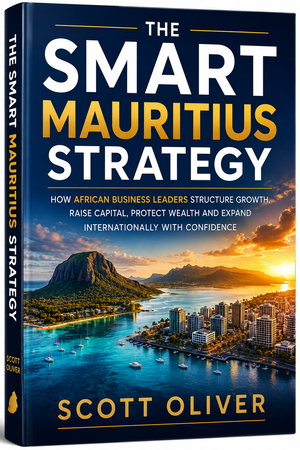
Free Chapter
The SMART Mauritius Strategy
Discover how African business leaders use smarter structures to raise capital, protect wealth and expand internationally.
Download NowThe Businesses That Adjust First Gain Flexibility.
The shift toward a more multi-currency Africa–China trading environment will not happen overnight. It does not need to. Even partial changes in settlement patterns can create a meaningful advantage for companies that adapt early.
The reward is not ideological. It is practical.
Businesses that understand their real currency exposure can reduce unnecessary conversion costs, align revenues and liabilities more intelligently, negotiate from a stronger position, and respond more calmly to changes in supply chains or financing terms.
In uncertain environments, flexibility is not a luxury. It is a competitive advantage.

Why Mauritius Is Becoming Part of the Conversation.
As Africa–China trade becomes more operationally complex, the question is not only what currency to use. The question is where these flows should be managed.
Mauritius is becoming increasingly relevant because it offers a stable, internationally recognised platform where multiple currencies can be managed within a single legal and financial environment. It already plays an established role in cross-border investment into Africa. It offers a respected legal framework, a sophisticated banking system, and growing relevance in Africa–Asia transactions.
For African businesses dealing with China, this matters. Mauritius is not a replacement for the dollar and it is not a political statement. It is a practical jurisdictional option for businesses that want more structure, more flexibility, and more control over complex cross-border flows.
In a world that is becoming more multi-currency, jurisdictions that can support calm and credible financial organisation become more valuable.

The Real Shift Is Mental.
The most important change is not technical. It is conceptual.
For years, many executives operated with a simple assumption: international business means dollars. That assumption is becoming less absolute. Not because the dollar has vanished, but because it is no longer the only currency shaping the commercial reality of Africa–China business.
The CEOs who recognise this early are not abandoning the dollar. They are simply moving beyond the habit of depending on it exclusively. They are learning to think in terms of systems rather than assumptions.
That change in mindset often comes before any meaningful change in structure. But it is the beginning of better strategy.
The Bottom Line.
Nothing dramatic has happened. But something meaningful has already begun.
Africa–China trade is becoming more operationally complex, more multi-currency, and more dependent on how transactions are structured rather than simply where they take place. Many CEOs have not adjusted yet because the shift has been gradual, uneven, and easy to ignore.
The companies that do adjust will not necessarily be the loudest. But they are likely to operate with more clarity, more flexibility, and fewer hidden costs than those that continue relying on yesterday's assumptions.
If your business touches China in any way, directly or indirectly, the strategic question is no longer whether currency complexity exists. The real question is whether you are managing it deliberately.
Scott Oliver is a retired British writer and independent researcher living in Mauritius. A former Royal Marines Commando and former Wall Street investment professional, he has spent more than four decades living and working internationally across 14 countries. During that time, he worked extensively in international wealth management, cross-border asset protection, international business structuring and global residency planning.
Today, Scott's focus is no longer on managing money or providing professional advice. Instead, through MauritiusWealth.mu, he writes independent educational articles designed to help successful African business owners ask better questions, make better decisions and, when appropriate, identify the right expertise to help protect everything they have spent a lifetime building.
His articles are published solely for general educational and informational purposes and should not be regarded as legal, financial, tax, immigration, investment or other professional advice. Every business owner's circumstances are unique, and readers requiring professional assistance should always consult an appropriately qualified and licensed professional.