

Expanding Across Borders? What African CEOs Must Understand About the New OECD Rules
Across Africa, a new generation of CEOs is building faster, smarter, and more internationally than ever before. What once took decades is now happening in years.
Regional players are becoming continental. Continental players are stepping onto the global stage. And with that expansion comes a quiet but critical shift that many have not yet fully understood.
The global tax environment has changed. Not in a dramatic, headline-grabbing way, but in a structural, system-wide way that alters how international businesses must be built from the ground up.
A Quiet Shift With Global Consequences
Over the past few years, more than 140 jurisdictions have committed to the OECD/G20 two-pillar framework for international tax reform. One of the most important parts of that framework is known as Pillar Two, or the Global Anti-Base Erosion rules.
In simple terms, Pillar Two is designed to ensure that large multinational enterprise groups with consolidated annual revenue of at least €750 million are subject to a minimum effective tax rate of 15% in each jurisdiction where they operate. If profits are taxed below that level in a particular country, a top-up tax may apply through domestic or foreign rules.
The intention is clear: reduce the ability of large multinational groups to shift profits across borders in order to achieve artificially low tax outcomes.
But while these rules are legally targeted at very large groups, the commercial implications extend much further. They are reshaping the environment in which all internationally active businesses operate, including those still growing toward scale.
Why This Matters Before You Reach Scale
Many CEOs assume these rules are something to deal with later, once the business becomes large enough to fall directly within the formal OECD thresholds. That assumption is understandable, but increasingly risky.
By the time a company reaches significant scale, its structure is usually already in place. Entities have been formed, investors have been onboarded, intellectual property may have been located somewhere, and revenue flows may already be established across jurisdictions.
At that point, changing the structure is no longer a simple adjustment. It can become a complex, expensive, and sometimes disruptive process involving tax authorities, lawyers, auditors, investors, lenders, and commercial counterparties.
The Real Risk Is Not Tax. It Is Structure.
This is where the conversation needs to shift.
For years, international structuring was often framed around a simple question: where can we pay less tax? That approach shaped decisions about holding companies, licensing arrangements, intellectual property, financing flows, and regional headquarters.
Today, that question is no longer sufficient.
The better question is this: can this structure survive investor scrutiny, tax authority review, transfer pricing analysis, future fundraising, and international expansion?
In other words, the risk is no longer just paying more tax. The risk is building a structure that becomes inefficient, constrained, or misaligned as the company grows.

The Global System Is Already Influencing Decisions
Even for companies below the largest OECD thresholds, the global system is already shaping behaviour.
Investors based in Europe, the United Kingdom, and other developed markets are increasingly attentive to how international structures are designed. Banks want transparency. Auditors want documentation. Tax authorities want substance. Larger counterparties often expect governance and compliance standards that reflect the new global environment.
This means that a company may not be directly subject to Pillar Two today, but may still feel its commercial effects through investor due diligence, banking relationships, acquisition discussions, supply-chain reviews, and cross-border partnerships.
In practical terms, internationally connected businesses are already operating within the gravitational pull of these rules, whether they realise it or not.
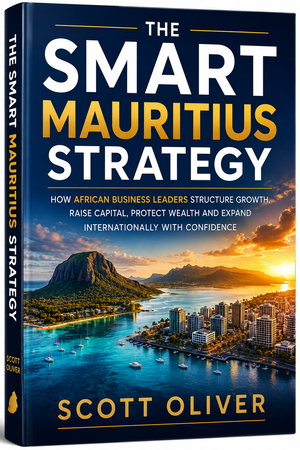
Free Chapter
The SMART Mauritius Strategy
Discover how African business leaders use smarter structures to raise capital, protect wealth and expand internationally.
Download NowCommon Mistakes Being Made Today
In this environment, several patterns are emerging among fast-growing companies.
Some continue to rely on older structuring ideas designed for a different era, assuming they can optimise later. Others build fragmented structures without a clear long-term logic, adding entities as opportunities arise rather than as part of a coherent international strategy.
Some underestimate the importance of substance: where management decisions are made, where people are employed, where value is created, where risks are controlled, and where intellectual property is genuinely developed or managed.
Others fail to consider how their structure will look to an outside investor, lender, acquirer, regulator, or tax authority five or ten years from now.
Perhaps most importantly, many underestimate how difficult it is to redesign a structure once it is operational, particularly when investors, contracts, employees, intellectual property, banking relationships, and multiple jurisdictions are already involved.
A Different Way to Think About Expansion
The most effective CEOs are beginning to approach this differently.
Instead of asking only where tax rates are lowest, they are asking where a structure can remain stable, compliant, defensible, and efficient as the business scales internationally.
This means prioritising substance, clarity, documentation, governance, and alignment over short-term optimisation. It means choosing jurisdictions that are recognised, connected, credible, and adaptable within the global system.
It also means thinking several steps ahead, not just to the next market entry, but to what the business will look like at ten times its current size.

Why This Moment Matters
There is a narrow window where these decisions are still relatively easy to make.
Before structures become entrenched. Before investor layers become complex. Before intellectual property is locked into the wrong place. Before revenue flows become difficult to unwind. Before operational momentum makes change expensive.
For CEOs expanding across borders today, this is that window.
The choices made now will shape not just tax outcomes, but flexibility, scalability, investor confidence, banking access, acquisition readiness, and long-term efficiency.
The Bottom Line
The global tax conversation is no longer just about compliance, and it is no longer only about the largest companies.
It is about how international businesses are designed.
For African CEOs building across borders, the most important shift is this:
The old question was: where can we reduce tax? The new question is: can this structure survive scrutiny, growth, and international expansion?
That is the real lesson of the new OECD environment. It is not simply about paying less tax. It is about avoiding the wrong structure.
Scott Oliver is a retired British writer and independent researcher living in Mauritius. A former Royal Marines Commando and former Wall Street investment professional, he has spent more than four decades living and working internationally across 14 countries. During that time, he worked extensively in international wealth management, cross-border asset protection, international business structuring and global residency planning.
Today, Scott's focus is no longer on managing money or providing professional advice. Instead, through MauritiusWealth.mu, he writes independent educational articles designed to help successful African business owners ask better questions, make better decisions and, when appropriate, identify the right expertise to help protect everything they have spent a lifetime building.
His articles are published solely for general educational and informational purposes and should not be regarded as legal, financial, tax, immigration, investment or other professional advice. Every business owner's circumstances are unique, and readers requiring professional assistance should always consult an appropriately qualified and licensed professional.
Expert Resources
- OECD Global Anti-Base Erosion Model Rules
The primary OECD resource explaining Pillar Two, the global minimum tax framework, model rules, administrative guidance, and implementation materials.
Read the OECD Pillar Two guidance - OECD Minimum Tax Implementation Handbook
A practical OECD handbook explaining the 15% minimum effective tax rate, the €750 million revenue threshold, and the basic mechanics of the global minimum tax rules.
Read the OECD implementation handbook - OECD 2026 Side-by-Side Package
An OECD update showing the latest simplifications, safe harbour changes, and technical developments in the global minimum tax framework.
Review the OECD 2026 update - PwC Pillar Two Country Tracker
A regularly updated country-by-country tracker showing how different jurisdictions are implementing Pillar Two and related global minimum tax rules.
Check the PwC Pillar Two tracker - Reuters Global Minimum Tax Update
A neutral news overview of recent international developments, including the continuing 15% global minimum tax framework and 2026 simplification efforts.
Read the Reuters global tax update