
Why Food in Mauritius Is Cleaner, Safer, and Closer to Europe Than You Think
It might surprise you to learn that Mauritius takes a very European approach to food safety. In fact, it's far closer to European Union standards than to the more relaxed rules used in the United States.
Let's talk about what that really means for your health, your shopping basket, and your peace of mind.
First, the basics: Who sets the rules?
Food safety in Mauritius is managed by a government system that includes the Ministry of Agro-Industry, the Pesticide Control Board, and food quality labs. These organizations oversee everything from farm chemicals to what shows up on your dinner plate.
While Mauritius follows international Codex Alimentarius guidelines, it often takes things further, choosing the more cautious path that mirrors the EU's approach. The government approves only certain food additives and pesticides, bans many others, and requires clear labeling on GMO products.
That alone puts Mauritius in a very different category from countries like the United States, where food regulations are more lenient and heavily influenced by agribusiness and lobbying.
What's in your food? A closer look at additives and GMOs
Have you ever looked at the back of a U.S. snack label and struggled to pronounce half the ingredients? Many of those chemical-sounding names are additives, food dyes, and preservatives. While they're legal in America, a good number of them are banned in Europe. Mauritius follows the European path.
You won't find products packed with controversial colorings or synthetic sweeteners on local shelves. And if genetically modified ingredients are present, they must be labeled. That's not the case in the United States, where GMO labeling is often avoided or hidden behind vague terms.
In Mauritius, there's no widespread GMO crop production. Imports are tightly controlled, and food transparency is taken seriously. You may still find some imported foods from less strict countries, but in general, you'll enjoy much more clarity about what's going into your body.
What about pesticides?
This is a big one.
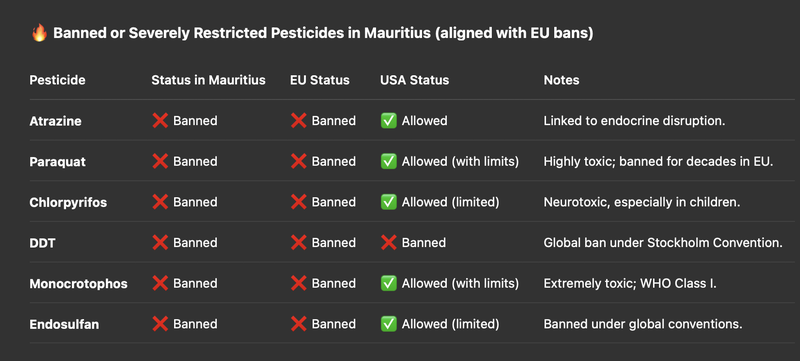
Mauritius allows the use of certain pesticides, but many of the most toxic ones—still legal in the United States—are completely banned. Chemicals like atrazine, paraquat, chlorpyrifos, monocrotophos, and endosulfan don't make it past the border. These are all linked to serious health risks and have already been outlawed across the EU.
Even the pesticides that are allowed are subject to strict rules. Farmers must register products, and residue levels are regularly tested. The Food and Agricultural Research & Extension Institute keeps a watchful eye on how pesticides are used and how much of them might end up in your food.
So if you're worried about chemical residues, Mauritius is clearly a safer place to eat fresh produce than the U.S.—especially if you shop at regulated outlets or buy organic.
Is glyphosate used? Yes, but not the toxic U.S. version
Now let's talk about the world's most controversial weedkiller: glyphosate.
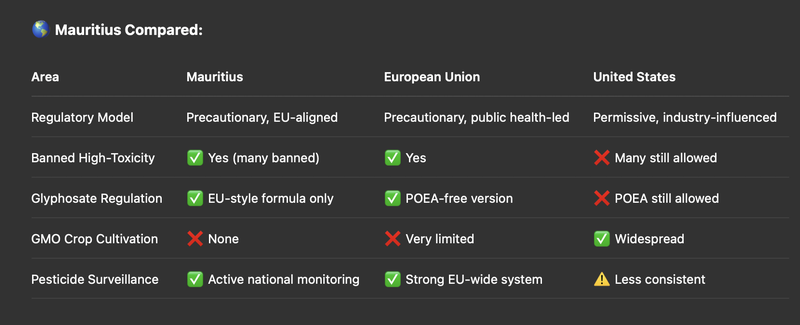
Yes, it's used in Mauritius, mainly in sugarcane farming. But here's the key difference. The formula used in Mauritius is more like the one used in Europe. That means it does not contain POEA, a toxic surfactant added to glyphosate products in the United States to increase absorption. POEA has been banned in the EU since 2016—and it's not allowed in Mauritius either.
So if you see glyphosate in use, it's not the same as the one sprayed across American fields. And while the government hasn't banned it outright, it is closely monitored, and public concern is growing.
What about hormones and antibiotics in meat?
Mauritius doesn't allow growth hormones in livestock, period. That's a direct contrast to the U.S., where hormone-treated beef and dairy are still common. Antibiotic use in Mauritius is also tightly controlled, with a growing focus on reducing unnecessary use.
So you're far less likely to be eating hormone-laced or antibiotic-heavy meat here.
So how does Mauritius really compare?
If we step back and look at the big picture, it becomes clear:
- Mauritius bans many of the same pesticides as the European Union
- GMO crops are not grown here and GMO food must be labeled
- Glyphosate is allowed, but only in its safer European formulation
- Growth hormones are banned and antibiotic use is limited
- Food additives are tightly controlled and EU-style labeling is enforced
- In contrast, the United States still permits many high-risk chemicals and additives that Europe and Mauritius have decided are simply not worth the risk.
But what about enforcement?
It's true that no system is perfect. Some small-scale farmers in Mauritius may not always follow best practices. But government bodies and non-profits are actively educating them and pushing for safer, more sustainable farming methods. And the formal food supply—supermarkets, major markets, and exporters—is held to high standards.
The bottom line
If food safety is important to you, and you want to live in a country where your health is protected through cautious regulation, Mauritius is a smart choice. You're not eating mystery chemicals. You're not being misled by unclear labels. And you're definitely not eating the same hormone-pumped meat or pesticide-laced produce that's still common in much of the United States.
In Mauritius, you can breathe a little easier—and eat a little safer.
Scott Oliver is a retired British writer and independent researcher living in Mauritius. A former Royal Marines Commando and former Wall Street investment professional, he has spent more than four decades living and working internationally across 14 countries. During that time, he worked extensively in international wealth management, cross-border asset protection, international business structuring and global residency planning.
Today, Scott's focus is no longer on managing money or providing professional advice. Instead, through MauritiusWealth.mu, he writes independent educational articles designed to help successful African business owners ask better questions, make better decisions and, when appropriate, identify the right expertise to help protect everything they have spent a lifetime building.
His articles are published solely for general educational and informational purposes and should not be regarded as legal, financial, tax, immigration, investment or other professional advice. Every business owner's circumstances are unique, and readers requiring professional assistance should always consult an appropriately qualified and licensed professional.
Expert Resources Used To Research and Write This Article:
- 1FOOD REGULATIONS 2024 – https://health.govmu.org/health/wp-content/uploads/2024/09/FOOD-REGULATIONS-2024-1.pdf ?
- Prohibited chemicals. https://www.mauritiustrade.mu/en/procedures/prohibited-chemicals ?
- The Mauritius Genetically Modified Organisms Act, 2004. https://ictpolicyafrica.org/en/document/wczo3g8kg2f?page=3 ?
- Focal Point Information - Food safety and quality. https://www.fao.org/food/food-safety-quality/gm-foods-platform/browse-information-by/country/country-page/en/?cty=MUS ?
- FAQ - Chicken breeding and production | Quality poultry | Mauritius – https://www.avipro.mu/en/faq ?
- The surfactant co-formulant POEA in the glyphosate-based herbicide RangerPro but not glyphosate alone causes necrosis in Caco-2 and HepG2 human cell lines and ER stress in the ToxTracker assay – https://pubmed.ncbi.nlm.nih.gov/36028061/ ?
- Poison-free Communities – Bans, Restrictions and Resistance –https://navdanyainternational.org/publications/glyphosate-bans-restrictions-across-the-world/ ?
- PAN International Consolidated List of Banned Pesticides – https://pan-international.org/wp-content/uploads/PAN-Consolidated-List-ExplanatoryNote-2024_FINAL.pdf ?
- Dangerous Chemical Control Act, 2004 - Government of Mauritius – https://muelex.govmu.org/portal/sites/muelex/dangerchem.htm ?
- Labeling Around the World – https://www.justlabelit.org/right-to-know-center/labeling-around-the-world/ ?
- International Labeling Laws. https://www.centerforfoodsafety.org/issues/976/ge-food-labeling/international-labeling-laws ?
- The Scourge of Pesticides Overuse in Mauritius – How Far are we in the Ongoing Ecological Disaster? – https://charlestelfaircentre.com/the-scourge-of-pesticides-overuse-in-mauritius-how-far-are-we-in-the-ongoing-ecological-disaster/ ?
- FOOD SAFETY IN MAURITIUS – https://subsites.wur.nl/upload_mm/3/2/a/30dca918-64cd-4abc-88a2-d8d5d6af6c08_FOOD%20SAFETY%20IN%20MAURITIUS%20final%2016%20july.pdf ?
- FOOD ACT 2022 Regulations made by the Minister under – https://health.govmu.org/health/wp-content/uploads/2023/09/DRAFT-FOOD-REGULATIONS-2023-.pdf ?
- Public Awareness of GM Products and Labeling of Products in Mauritius – https://www.repository.mu/mrc/op/op.DownloadFromOutside.php?documentid=685&;version=1 ?
- Mauritius - USDA Food Safety and Inspection Service – https://www.fsis.usda.gov/inspection/import-export/import-export-library/mauritius ?
- The Mauritius Food Standards Agency Act, no. 16 of 2022. | FAOLEX – https://www.fao.org/faolex/results/details/en/c/LEX-FAOC215773/ ?
- Polyethoxylated tallow amine – https://en.wikipedia.org/wiki/Polyethoxylated_tallow_amine ?
- Antibiotic use in livestock – https://en.wikipedia.org/wiki/Antibiotic_use_in_livestock ?
- Risk Assessment of Growth Hormones and Antimicrobial Residues in Meat – https://pmc.ncbi.nlm.nih.gov/articles/PMC3834504/ ?