
46 Reasons More British People Over 50 Are Choosing Mauritius For Retirement

For many British people, retirement is no longer simply about stopping work. It is about enjoying a better quality of life, protecting the wealth they have spent decades building, and living somewhere that is safe, welcoming, and financially sensible.
Mauritius offers a combination of advantages that very few countries can match. It combines a warm tropical lifestyle with political stability, attractive residency options, an internationally respected financial sector, and a legal and administrative system that British citizens often find reassuringly familiar.
Just as importantly, many aspects of everyday life feel surprisingly comfortable. People drive on the left-hand side of the road, English is used throughout government and professional life, British-style electrical plugs are standard, and many familiar foods, sports, institutions, and traditions remain part of daily life.
None of these similarities is life-changing on its own. Together, however, they create something much more valuable: Mauritius does not feel as foreign as many overseas retirement destinations. For British retirees, that familiarity can make settling into a new country faster, easier, and far less intimidating.
No country is perfect, and Mauritius will not be the right choice for everyone. However, for British citizens looking for a better lifestyle, greater personal security, international diversification, and long-term financial-planning opportunities, Mauritius deserves serious consideration.

The following list explains some of the principal lifestyle, residency, legal, tax, banking, investment, and wealth-planning benefits that Mauritius may offer British retirees and investors.
- A Warm Climate and Outdoor Lifestyle. Mauritius offers a tropical climate, warm coastal living, beautiful beaches, mountain scenery, and an outdoor lifestyle throughout most of the year. For British retirees accustomed to long, dark winters, the opportunity to walk, swim, garden, play golf, visit the beach, and spend more time outdoors every single day of the year can be one of the most immediate improvements in daily life.
- A More Relaxed Pace of Life. Many British retirees are attracted by the opportunity to leave behind cold winters, crowded cities, long commutes, and the constant pressure of life in the United Kingdom. Mauritius generally offers a slower and more relaxed rhythm, particularly outside Port Louis and the busiest commercial areas. Retirement can begin to feel like a genuine new chapter rather than simply the end of a career.
- English Is the Official Language. English is used in legislation, government administration, the courts, banking, contracts, education, and professional services. French and Mauritian Creole are heard more frequently in everyday conversation, but British retirees can generally deal with government departments, lawyers, banks, doctors, accountants, and other professionals in English. This removes one of the largest barriers associated with retiring in many other countries.
- Driving Feels Surprisingly Familiar. Mauritius drives on the left-hand side of the road, as does the United Kingdom, and right-hand-drive vehicles are standard. British drivers will also recognise roundabouts, many familiar road signs, and road classifications such as the M1, M2, and A-roads. Local traffic conditions still require care, but most experienced British drivers do not have to relearn the most fundamental rules of the road.
- The Same Electrical Plugs and Voltage. Mauritius commonly uses the British-style Type G three-pin plug and a 230-volt electrical supply. Most electrical appliances brought from the United Kingdom can therefore be used without a plug adapter or voltage converter, although individual equipment should always be checked before use. It is a small convenience, but one that makes setting up a new home considerably easier.
- Familiar Foods, Shops, and British Products. Supermarkets in Mauritius stock a mixture of Mauritian, French, South African, European, and British products. Imported goods can be more expensive, but retirees can still find many familiar brands, teas, biscuits, cereals, sauces, and household products. At the same time, local markets offer fresh tropical fruit, vegetables, fish, spices, and locally produced food. And yes! Marmite is available in most stores!
- A Strong Tea Tradition. Tea is not merely an imported British habit in Mauritius. The island has its own long history of tea cultivation and production. Tea estates, local brands, and the everyday custom of drinking tea provide another small cultural familiarity for British residents while offering a distinctly Mauritian version of a familiar tradition.
- Familiar Sporting Interests. Football, rugby, cricket, golf, and horse racing are all known and followed in Mauritius. British retirees can continue watching many familiar international competitions while also discovering local clubs, golf courses, and community activities. The climate also makes outdoor sport possible during far more of the year than would normally be practical in Britain.
- A Multicultural and Welcoming Society. Mauritius is home to communities with African, Indian, European, and Chinese heritage. Hinduism, Christianity, Islam, and other faiths are openly practised, and the island celebrates a remarkably diverse calendar of religious and cultural festivals. This creates a society that is internationally minded while maintaining strong family, community, and traditional values.

- Religious Freedom and Cultural Tolerance. Temples, churches, mosques, and other places of worship are found throughout the island, sometimes within a short distance of one another. Religious festivals are publicly celebrated and widely respected. British retirees from many different cultural and religious backgrounds can generally practise their faith openly or live secularly without feeling excluded from the wider community.
- A Safe, Peaceful, and Politically Stable Country. Mauritius is widely regarded as one of Africa's safest and most stable democracies. It has a long record of peaceful political transitions, an independent judiciary, respect for private property, and a generally calm social environment. For retirees, personal security and political stability can be every bit as important as climate or taxation.
- A Familiar Legal Foundation. Mauritius operates under a mixed legal system influenced by both French civil law and British common law. Corporate, trust, commercial, and financial-services matters are strongly shaped by Commonwealth legal principles, while final appeals in many cases may be heard by the Judicial Committee of the Privy Council in London. For British retirees and investors, this creates a legal framework that often feels more familiar and predictable than those of many alternative jurisdictions.
- Residency Options for Retirees. British citizens aged 50 or over may qualify for a 10-year Mauritius Retirement Permit by meeting the applicable financial and administrative requirements. This gives qualifying retirees the opportunity to live legally in Mauritius for an extended period while enjoying the island's lifestyle, infrastructure, and international connectivity. The precise requirements should always be checked at the time of application.
- Residency Options for Investors and Business Owners. Mauritius also offers residence pathways for qualifying investors, self-employed professionals, entrepreneurs, and property buyers. This can be valuable for British citizens who want more than an offshore financial structure and are looking for a genuine second home, a long-term Plan B, or a base from which to conduct international business.
- Residence Through Approved Property Ownership. Foreign buyers may qualify for residence by purchasing approved real estate that meets the applicable government threshold and scheme requirements. This can allow a British buyer to combine a lifestyle property with long-term residence. However, not every property qualifies, and buyers should confirm the development's approval status, legal structure, ongoing charges, tax implications, and resale conditions before committing.
- No General Capital Gains Tax in Mauritius. Mauritius does not generally impose capital gains tax on the sale of investments or appreciating assets. This can make it attractive for holding investment portfolios, shares, property interests, and international structures. However, the absence of Mauritian capital gains tax does not automatically remove tax exposure in the United Kingdom or in any other jurisdiction connected to the investor or the asset.
- No Annual Wealth Tax. Mauritius does not impose an annual tax simply because an individual owns substantial wealth. For retirees and investors with accumulated savings, portfolios, businesses, or international assets, this can make long-term wealth preservation simpler and more predictable than in jurisdictions that impose recurring wealth taxes.
- No Inheritance Tax in Mauritius. Mauritius itself does not impose inheritance tax or estate duty in the same way as the United Kingdom. This can make the country attractive for succession and estate planning. However, British citizens and UK-connected families must still consider UK inheritance-tax rules, the location of assets, the residence status of the individuals involved, and the structure through which those assets are held.
- A Competitive and Relatively Simple Tax System. Mauritius is known for a comparatively straightforward tax framework and internationally competitive rates. The actual amount payable by an individual or company depends on residence, income source, deductions, activities, and any available exemptions. British retirees should therefore avoid assuming that moving to Mauritius automatically removes UK tax obligations or makes all foreign income tax-free.
- Global Business Company Structures. A Mauritius Global Business Company, commonly known as a GBC, may be used for international investment, holding-company activity, cross-border trading, private-investment structures, and regional expansion into Africa or Asia. Qualifying income may receive partial exemptions, but any benefit depends on substance, activity, management, beneficial ownership, and compliance with Mauritian and international rules.

- Mauritius Discretionary Trusts. A properly drafted Mauritius discretionary trust may help separate legal ownership from beneficial enjoyment, allowing wealth to be managed according to the settlor's wishes while supporting succession planning, family governance, and asset segregation. However, a trust does not automatically eliminate UK inheritance tax, divorce claims, creditor claims, or anti-avoidance rules. Its effectiveness depends on the facts and the quality of the legal and tax structuring.
- Tax-Efficient Compounding of Wealth. Investments held through a properly structured Mauritius company, trust, fund, or investment vehicle may benefit from reduced tax drag, depending on the type of income, source jurisdiction, treaty access, substance, and tax position of the investor. This is not the same as saying that every investment grows tax-free. The real advantage is the possibility of creating an efficient, recognised framework for long-term international investment.
- Potential to Simplify Succession and Probate. Assets properly held in a Mauritius trust or other succession structure may pass under the terms of that structure rather than through ordinary probate procedures. This can sometimes allow for more private, orderly, and efficient administration. The timing of distributions will still depend on the governing documents, trustee duties, banking checks, tax considerations, and any disputes among interested parties.
- Privacy Without Secrecy. Mauritius offers a meaningful degree of lawful financial and commercial privacy while complying with anti-money-laundering, beneficial-ownership, tax-transparency, and international reporting requirements. It is not a jurisdiction for hiding assets from tax authorities or regulators. It is a jurisdiction in which properly disclosed structures can be managed with professional discretion.
- Asset Segregation and Creditor Planning. Assets held through a properly established trust, company, foundation, or investment vehicle may be separated from direct personal ownership and governed under a defined legal framework. This can be useful for succession planning, family disputes, commercial risks, or the management of wealth for younger beneficiaries. Offshore structures are not invulnerable, however, and courts can examine sham arrangements, fraudulent transfers, retained control, matrimonial claims, and creditor intent.
- Control Without Direct Personal Ownership. A well-designed discretionary trust, private trust company, foundation, or holding structure may allow a family to preserve influence and strategic direction without keeping every asset in one person's name. This can assist with succession, incapacity planning, family governance, and the gradual transfer of responsibility to younger generations. Too much retained control, however, can undermine the intended legal or tax benefits.
- Multi-Currency Banking. Mauritian banks commonly offer accounts in GBP, USD, EUR, and other major currencies. This allows British retirees and investors to hold income, savings, and investments across several currencies rather than remaining entirely dependent on sterling. It can also make it easier to receive pensions, investment income, rental income, or business proceeds from different countries.
- No General Exchange Controls. Mauritius generally allows capital to move into and out of the country without the exchange-control restrictions found in some other jurisdictions. This supports international banking, investment, business activity, and repatriation of funds. Normal source-of-funds checks, tax reporting, sanctions screening, and banking compliance requirements still apply.
- Greater International Diversification. Establishing a legitimate financial base in Mauritius can help reduce overdependence on one currency, one banking system, one political environment, or one tax jurisdiction. The strategic benefit is not simply that money is held offshore. It is that a retiree or investor may be able to spread financial, political, and currency exposure more intelligently across several jurisdictions.
- A Serious International Financial Sector. Mauritius has developed a substantial financial-services ecosystem that includes banks, management companies, trust companies, fiduciaries, fund administrators, lawyers, accountants, investment professionals, and corporate-service providers. Many are trained in British, Commonwealth, French, or international systems, making the jurisdiction easier for British clients to understand and navigate.

- Experienced English-Speaking Professionals. British retirees and investors can access English-speaking lawyers, accountants, tax advisers, trustees, bankers, property professionals, and immigration specialists. Many have international qualifications or experience working with British and Commonwealth clients. The choice of adviser remains critical, because a strong jurisdiction cannot compensate for weak, careless, or conflicted professional advice.
- International Compliance and Regulatory Recognition. Mauritius has positioned itself as a transparent and regulated international financial centre rather than a traditional secrecy jurisdiction. It operates within international anti-money-laundering, tax-reporting, beneficial-ownership, and financial-regulatory frameworks. For British investors, this can reduce the legal and reputational risks associated with using poorly regulated or secretive jurisdictions.
- A Broad Double-Taxation Treaty Network. Mauritius has entered into double-taxation agreements with numerous countries across Africa, Asia, Europe, and the Middle East, including the United Kingdom. For the right investor or business structure, these treaties may help reduce double taxation and improve the efficiency of cross-border income or investment. Treaty benefits are never automatic and depend on residence, substance, beneficial ownership, anti-abuse rules, and the relevant treaty provisions.
- A Useful Base for Investment into Africa and Asia. Mauritius occupies a strategic position between Africa and Asia and has long promoted itself as a platform for international investment into both regions. British entrepreneurs, investors, and family businesses may use Mauritius as a regional base for holding companies, investment structures, administration, and expansion, provided there is genuine commercial purpose and sufficient local substance.
- A Potential Base for Internationally Mobile British Citizens. Mauritius may be particularly relevant for British citizens who have lived internationally, former non-doms, globally mobile families, and individuals considering a future move away from the United Kingdom. However, UK tax rules have changed significantly, and old assumptions about domicile, residence, offshore trusts, and inheritance tax may no longer be reliable. Current specialist advice is essential.
- A Stable Banking and Commercial Environment. Mauritius has a long-established banking system, recognised commercial institutions, and a legal framework designed to support domestic and international financial activity. No banking system is risk-free, but the country offers British clients an additional financial centre outside the United Kingdom in which to hold, manage, and diversify legitimate assets.
- International Air Connections. Mauritius is connected by air to the United Kingdom, Europe, the Middle East, Africa, and Asia. Routes and frequencies change, and some journeys may require connections, but British retirees can remain within practical reach of family, friends, business interests, and international travel hubs.
- Modern Private Healthcare Options. Mauritius has private hospitals, clinics, laboratories, pharmacies, dentists, and medical specialists, particularly around the main population centres. The system is smaller than that of the United Kingdom, and highly specialised treatment may sometimes require travel abroad. Nevertheless, many routine consultations, tests, procedures, and emergency services are available privately at costs that British residents may find comparatively manageable.
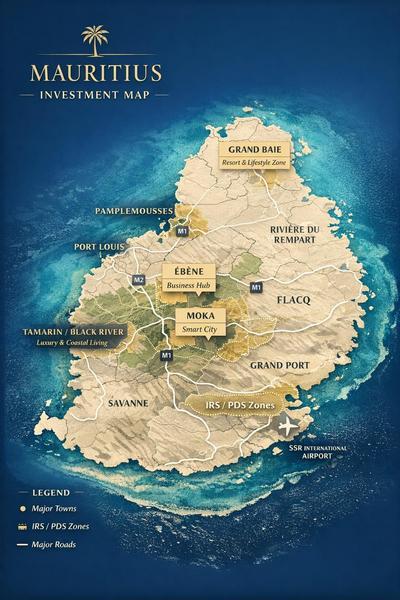
- Property Choices for Different Lifestyles. British retirees can choose from coastal apartments, villas, gated developments, golf estates, village homes, and properties closer to commercial centres. The north and west are particularly popular with expatriates because of their beaches, restaurants, shops, medical facilities, and established international communities. Rental and purchase costs vary considerably by location, quality, and proximity to the sea.
- Public Beaches and Accessible Coastal Living. Mauritius has numerous public beaches that can be enjoyed without paying private-club membership fees. Retirees can walk, swim, relax, and watch the sunset in some of the island's most beautiful coastal areas. Beach conditions, facilities, parking, shade, currents, and accessibility vary, so choosing the right area remains important.
- Fresh Local Produce and Markets. Local markets and roadside vendors offer tropical fruit, vegetables, herbs, spices, and fresh food throughout the year. British retirees who are willing to shop locally rather than relying entirely on imported supermarket products can enjoy greater variety, a closer connection to the community, and potentially lower everyday food costs.
- Opportunities for a Healthier Daily Routine. Warm weather and access to beaches, parks, swimming, walking, and outdoor activities can make it easier to maintain an active lifestyle. Mauritius does not automatically make anyone healthier, but the environment can support better routines for retirees who choose to take advantage of it.
- A Neutral and Internationally Oriented Country. Mauritius is a small, outward-looking island nation with commercial, cultural, and diplomatic links across Africa, Europe, Asia, and the Middle East. For British retirees and investors seeking a relatively neutral base outside the political pressures of larger countries, this can be an important long-term advantage.
- The Choice to Use Mauritius Without Relocating. A British investor does not necessarily need to become resident in Mauritius to use certain properly established companies, trusts, funds, or investment structures. At the same time, the country offers qualifying individuals the possibility of living there. This gives Mauritius an unusual combination of international structuring opportunities and genuine lifestyle appeal.
- A Genuine Plan B Outside the United Kingdom. For some British citizens, Mauritius is not simply a holiday destination or tax-planning jurisdiction. It can provide a second residence, an alternative banking base, an international investment platform, a warmer retirement location, and a degree of geographic diversification. A well-planned move can therefore address lifestyle, residency, succession, and financial objectives together rather than treating each issue separately.
- A Place That Can Feel Familiar Without Feeling Like Britain. Mauritius offers many reassuring similarities to the United Kingdom: left-hand driving, English-language administration, British-style plugs, Commonwealth legal traditions, familiar sports, and access to British products. At the same time, it offers tropical scenery, multicultural traditions, warmer weather, and a more relaxed island lifestyle. That balance of familiarity and difference is one of its greatest attractions for British retirees.

Final Thoughts
For many British people, retirement represents one of the most important decisions they will ever make. It is about far more than choosing a country with good weather or lower taxes. It is about deciding where you want to spend the next chapter of your life, where your wealth will be protected, where you will feel secure, and where you can enjoy the freedom you have spent a lifetime working to achieve.
Mauritius will not be the right choice for everyone. Every family has different priorities, financial circumstances, health considerations, and long-term goals. However, for many British retirees, Mauritius offers a combination of advantages that is genuinely difficult to find elsewhere.
A warm climate, political stability, English-speaking institutions, familiar legal traditions, attractive residency options, internationally respected financial services, and an exceptional quality of life together create a compelling destination for retirement and long-term wealth planning.
Having gone through the relocation process myself, I understand both the excitement and the uncertainty that comes with making such a significant decision. I also know how difficult it can be to separate reliable information from marketing material or conflicting advice found online.
That is why MauritiusWealth.mu exists.
My role is not to sell property, provide legal advice, or recommend financial products. My role is to help you understand your options, avoid costly mistakes, and introduce you to experienced, independent professionals when specialist advice is needed.
If you are considering retiring, investing, purchasing property, or establishing an international wealth-planning strategy in Mauritius, I invite you to arrange a confidential introductory conversation. Together, we can discuss your objectives, answer your questions, and explore whether Mauritius is genuinely the right fit for you and your family.
Your retirement is too important to leave to chance. Make your decision with confidence, based on facts, independent guidance, and careful planning.

Scott Oliver is a retired British writer and independent researcher living in Mauritius. A former Royal Marines Commando and former Wall Street investment professional, he has spent more than four decades living and working internationally across 14 countries. During that time, he worked extensively in international wealth management, cross-border asset protection, international business structuring and global residency planning.
Today, Scott's focus is no longer on managing money or providing professional advice. Instead, through MauritiusWealth.mu, he writes independent educational articles designed to help successful African business owners ask better questions, make better decisions and, when appropriate, identify the right expertise to help protect everything they have spent a lifetime building.
His articles are published solely for general educational and informational purposes and should not be regarded as legal, financial, tax, immigration, investment or other professional advice. Every business owner's circumstances are unique, and readers requiring professional assistance should always consult an appropriately qualified and licensed professional.