
Beyond Residency: What Happens When Your Entrepreneur Clients Need More Than a Visa?

Residency may be the beginning of the client relationship, not the end. As entrepreneur clients become more international, questions about companies, banking, intellectual property, tax residence, trusts, foundations, investments and succession often follow. For mobility, relocation and residency professionals, that creates both a challenge and an opportunity.
Imagine a 32-year-old British e-commerce entrepreneur approaches you because he wants a second residence.
His business generates $150,000 a year. He sells internationally, has no employees, no outside investors and relatively little corporate infrastructure.
His priorities are straightforward. He wants somewhere attractive to live, greater international mobility, a simple business structure and, quite reasonably, he does not want to pay more tax than the law requires.
You help him solve the residency problem.
Job done?
Perhaps.
But what happens if that client comes back to you ten years later?
The business now generates $15 million a year. There are employees, substantial cash reserves, valuable intellectual property, international banking and payment relationships and perhaps several companies. An investor wants to acquire 20% of the business. The founder thinks the entire company could eventually be sold.
Suddenly he is asking you questions that have very little to do with obtaining a residence permit.
Where should my international business be structured? Where should my intellectual property sit? What about my accumulated wealth? Should I consider a trust or foundation? And what happens if I eventually sell the company?
If you work with internationally mobile entrepreneurs, these are increasingly important questions.
They also create an interesting commercial opportunity.

Your Client Has Changed
The entrepreneur who originally came to you looking for residency may eventually become a very different client.
At $150,000 a year, keeping things simple can make perfect sense. A territorial or low-tax jurisdiction may be entirely appropriate. Paraguay, Panama and other jurisdictions can be attractive in the right circumstances. The UAE has also attracted large numbers of internationally mobile entrepreneurs, although its corporate tax environment has evolved considerably.
There is nothing inherently wrong with seeking low taxation.
There is also nothing particularly clever about paying more tax than the law requires.
But success changes the questions.
Your entrepreneur may now have customers in dozens of countries. Products could be manufactured in one country, warehoused in another and sold into several more. The company might use international banks, merchant acquirers, payment platforms, fulfilment companies and local distributors.
VAT, GST, sales taxes, customs duties and other indirect-tax obligations may arise in markets where customers or goods are located, regardless of where the parent company happens to be incorporated.
Instead of asking only "Where can I legally pay the least tax?", your client may now need answers to questions such as:
- Where is my company actually tax resident?
- Where is it managed and controlled?
- Could my activities create a permanent establishment somewhere else?
- Which company should contract with customers?
- Where should international customer payments be received?
- What VAT, GST, sales tax or customs obligations could arise?
- What withholding taxes apply when money crosses borders?
- Can the business legitimately benefit from tax treaties?
- Where should intellectual property be owned and managed?
- Will banks and payment providers be comfortable with the structure?
- How should accumulated business and family wealth eventually be held?
- Would a trust or foundation ever be appropriate?
- What will an institutional investor discover during due diligence?
- What happens if the founder eventually sells the business?
These are not normally questions a residency consultant should attempt to answer alone.
But they may be questions your clients expect you to help them find answers to.
The opportunity is not necessarily to become an international tax, corporate or trust specialist yourself. It is to know where to find the appropriate expertise when your client needs it.
What Happens After the Residence Permit?
This is where the traditional mobility model can become surprisingly narrow.
A consultant may spend months helping a successful entrepreneur obtain residency in a new country. During that process, the consultant learns about the client's family, business, objectives and international plans.
Then the permit is approved.
The client's international life, however, is only beginning.
The next conversation might involve a company. Then banking. Then an investment. Then intellectual property. Then asset ownership. Then succession planning.
Each time the answer is simply "You'll need to speak to somebody else about that", part of the client relationship potentially leaves the room.
There is another model.
You remain the trusted relationship. Specialist professionals provide the regulated or technical expertise your client requires.
That is where adding another jurisdiction and another professional network to your international toolkit can become valuable.
DO YOU ADVISE INTERNATIONALLY MOBILE ENTREPRENEURS?
If clients already ask you questions that go beyond residency, you do not necessarily need to build your own corporate, trust or international structuring department. MauritiusWealth.mu can introduce appropriate cases to independent licensed Mauritius professionals while you remain involved in the client relationship.
Talk privately about adding Mauritius to your international toolkit »

The International Tax World Is Changing Too
There is a popular idea that international organisations are going to eliminate zero-tax countries.
That is too simplistic.
Countries remain sovereign. Paraguay can operate a territorial tax system. Panama can decide how it taxes foreign income. Other countries can create their own incentives.
Nor does the OECD's 15% global minimum corporate tax mean that every entrepreneur in the world must suddenly pay 15%.
The OECD's Pillar Two rules are principally aimed at very large multinational groups with consolidated annual revenues of at least €750 million. Most entrepreneur-owned businesses are nowhere near that threshold.
But something important is happening.
The international tax system is becoming much less tolerant of situations where the paperwork says one thing and the economic reality says another.
Governments exchange more financial information. Banks know more about the people behind companies and accounts. Tax authorities have increasingly sophisticated rules dealing with Controlled Foreign Companies, beneficial ownership, permanent establishments, corporate residence and where businesses are really managed.
Countries have also adopted the Common Reporting Standard, usually known as CRS, while international tax treaties increasingly contain provisions designed to prevent treaty abuse.
In simple English, the direction is clear:
If your client claims a business is genuinely based somewhere, they should increasingly be prepared to demonstrate why.
That does not mean zero tax is dead.
It means substance matters more than it used to.
Tax Efficiency and Tax Certainty Are Not the Same Thing
This distinction can be particularly useful when speaking with successful entrepreneur clients.
Tax efficiency asks: How can I legally reduce unnecessary taxation?
Tax certainty asks a broader set of questions.
- Where is the company resident?
- Where should its profits be taxed?
- Which country's laws govern it?
- What tax treaties can legitimately be used?
- What substance is required?
- How will dividends, interest, royalties and other payments be treated?
- How will the structure be viewed by banks, payment institutions, investors, auditors and tax authorities?
No international structure can guarantee that a tax authority will never challenge something.
But there is a major difference between a structure designed primarily around obtaining the lowest possible headline tax rate and one deliberately built around clear laws, genuine commercial activity and defensible international tax principles.
As your client's business becomes larger, that distinction can become extremely valuable.
And this is where Mauritius may deserve a place in your international toolkit.
Why Mauritius?
Mauritius does not need to pretend that it is a zero-tax country.
The standard corporate income tax rate is generally 15%. Certain qualifying categories of income can benefit from partial exemptions, subject to statutory conditions.
This distinction matters.
You will sometimes hear people say that a Mauritius Global Business Company simply pays an effective 3% tax.
That is not generally correct.
An 80% partial exemption can apply to specified categories of qualifying income, including certain foreign dividends, interest, profits attributable to a foreign permanent establishment and specified financial activities. Where the exemption applies, it can produce an effective tax rate of 3%, but it should never be assumed that every Mauritius company or every type of foreign income automatically qualifies.
That may be less exciting than advertising "0% tax."
But for the successful international entrepreneur, the headline tax rate is only part of the calculation.
Mauritius occupies an unusual position: African geography, British and French legal heritage, English-language corporate legislation, an international financial centre, extensive tax-treaty relationships, and commercial links stretching from Africa to Europe and Asia.
That combination can become increasingly relevant as your client's business becomes more international, more valuable and more visible.
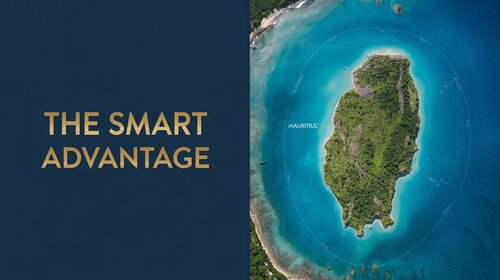
It is also worth putting Mauritius into perspective. This is a country with a population of only about 1.24 million people, yet it has developed a sophisticated international financial-services sector and regulatory infrastructure that would normally be associated with a much larger economy.
The economy grew by 3.2% in 2025, according to Statistics Mauritius, and financial and insurance activities were among the important contributors to growth. Mauritius's international financial centre is therefore not simply a tax concept. Financial services form an important part of the country's real economy.
Mauritius Is Not Intended to Be a Paper Company Jurisdiction
This point is especially important when discussing Mauritius with clients.
Simply incorporating a company in Mauritius does not mean everything the company does automatically becomes Mauritian for tax purposes.
A genuine international structure needs to make commercial sense.
Depending on the company, its activities, licences and the tax treatment being claimed, appropriate Mauritius substance may involve resident directors, local administration, accounting records, banking, expenditure and genuine decision-making in Mauritius. Where the nature and scale of the business require it, people, expertise and premises may also become relevant.
This becomes particularly important when the founder lives somewhere else.
If important decisions are actually being made from London, Toronto, Paris or another country, simply registering the company in Mauritius does not make questions about management, control and tax residence disappear.
The paperwork and the economic reality need to tell a coherent story.
For advisers whose clients are becoming more sophisticated, that is not a weakness of Mauritius.
It can be one of its strengths.

The Treaty Network Changes the Calculation
Mauritius has concluded 45 tax treaties, according to the Mauritius Revenue Authority.
These include agreements with major economies and financial centres such as the United Kingdom, France, Germany, India, China, Singapore and the UAE, as well as numerous African countries.
The African network is particularly interesting. Mauritius has tax treaties with countries including South Africa, Botswana, Ghana, Rwanda, Uganda, Namibia, Zimbabwe, Mozambique, Madagascar and Egypt.
Why does this matter?
Because international businesses do not only pay corporate income tax.
Money moving from one country to another may also face withholding taxes on dividends, interest, royalties and other payments. A properly applicable tax treaty can sometimes reduce those taxes significantly.
But this is where advisers need to be particularly careful.
Creating a Mauritius company does not automatically give a client the right to use every Mauritius tax treaty.
Treaty eligibility depends on the particular treaty, tax residence, beneficial ownership, the nature of the transaction, substance and applicable anti-abuse provisions.
The objective should not be to create a Mauritius company merely so somebody can wave a tax residence certificate at another country's tax authority.
The objective is to determine whether Mauritius has a genuine commercial role within the client's international structure.
Your Client's Most Valuable Assets May Eventually Be Invisible
There is another change that often occurs as an online or e-commerce business grows.
In the beginning, most of the value may appear to be in the products being sold and the cash coming through the website.
Years later, some of the most valuable assets may be things nobody can physically touch.
The brand. Trademarks. Proprietary software. Technology. Designs. Customer relationships. Data and databases, subject to applicable privacy and data-protection laws. Domain names. Copyright. Business processes and other intellectual property.
A successful international business therefore needs to consider where intellectual property is legally owned, where it was developed, where it is genuinely managed, which group companies use it and how transactions between related companies are priced.
Simply transferring a valuable trademark or software platform into a Mauritius company does not automatically transform the income it generates into income taxed at 3%.
Intellectual property taxation is considerably more complicated than that. The nature of the IP, where research, development and value creation occurred, the people managing it, transfer-pricing rules, substance requirements and the particular income involved can all matter.
For the adviser, however, the larger point is straightforward.
Once your client's brand, software or other intellectual property becomes worth millions of dollars, where it sits inside the international group becomes a strategic question, not merely an accounting detail.

Mauritius Chose Substance Over Secrecy
This may be one of the most important parts of the Mauritius story.
Mauritius has spent years adapting its international financial sector to changing global standards.
It participates in the Common Reporting Standard, FATCA, Country-by-Country Reporting and the Multilateral Instrument affecting international tax treaties. Mauritius has also implemented legislation connected with the international minimum-tax framework for the very large multinational groups to which those rules apply.
Mauritius is also not on the Financial Action Task Force's June 2026 list of jurisdictions under increased monitoring, commonly called the FATF grey list.
In other words, Mauritius is not building its international financial centre around the proposition: Come here because nobody can see you.
The proposition is almost the opposite: Come here because you don't need to hide.
For successful internationally mobile entrepreneurs, that distinction can become increasingly important.

An English-Language Advantage
Language matters.
It matters particularly when your client is dealing with company law, financial regulation, contracts, banks and government authorities.
Mauritius has an unusual history. The French ruled the island before the British. The British then governed Mauritius from 1810 until independence in 1968.
The result is a hybrid legal system combining important elements of French civil law and British common law.
French and Mauritian Creole are widely spoken in everyday life, but English has a central role in Parliament, government and modern corporate legislation. Important legislation governing companies and international financial services is available and administered in English.
For entrepreneurs from Britain, Canada and many international businesses in Europe, this can make Mauritius considerably easier to understand and navigate than jurisdictions where the legal and administrative environment operates primarily in another language.
Dubai is somewhat different. English is extensively used in international business there, so it would be misleading to suggest that an English-speaking entrepreneur cannot comfortably conduct business in Dubai.
But Mauritius offers a particularly interesting combination of English-language corporate and financial legislation with an African location and a legal tradition influenced by both Britain and France.

Mauritius Is More Than a Gateway Out of Africa
Mauritius is frequently promoted as a gateway for African entrepreneurs investing internationally.
That is certainly part of its appeal.
But it works in the opposite direction too.
Your client might be a British technology or e-commerce entrepreneur expanding internationally. A Canadian founder building operations across several continents. A European family business looking for an international base from which to hold investments and conduct cross-border business.
None of them necessarily needs to conduct a single transaction in Africa for Mauritius to deserve consideration.
But if Africa is part of their future, Mauritius gains another strategic advantage.
The island has banks, lawyers, accountants, corporate administrators, investment professionals, fund managers and regulated management companies accustomed to dealing with cross-border business.
This means Mauritius can potentially serve two different international flows: African entrepreneurs looking outward to the rest of the world, and entrepreneurs from Britain, Europe, Canada and elsewhere looking towards Africa or simply looking for an internationally credible base.
Mauritius should not be thought of simply as an African tax jurisdiction. It is an international financial centre that happens to occupy a strategically useful position between Africa, Asia and the wider world.
Think Beyond the Company. Think About the Group.
When an entrepreneur first comes to you, the international structuring question may sound very simple:
Where should I incorporate my company?
As the business grows, that may become the wrong question.
The better question can become:
How should my international group be structured?
A growing business may eventually have a parent or holding company, operating subsidiaries in important markets, intellectual property arrangements, warehouses, employees, distributors, investments and bank accounts in several countries.
Mauritius can potentially form part of that wider architecture.
Depending on the commercial circumstances and appropriate professional tax and legal advice, a Mauritius company might perform headquarters, holding, investment, financing, management or other genuine international functions while local operating subsidiaries, employees, warehouses or distributors remain in the countries where the underlying business actually takes place.
This is a very different concept from creating an offshore company and pretending every dollar earned around the world belongs there.
The structure should follow the business.
Banking and Payments Become Part of the Strategy
For an e-commerce entrepreneur, there is another practical reality that can become impossible to ignore.
You have to get paid.
A small business processing $150,000 a year and an international company processing $15 million are very different propositions for banks and payment institutions.
As transaction volumes increase, banks, merchant acquirers and payment providers may want to understand exactly who owns the company, where it operates, what it sells, where its customers and suppliers are located, where its money comes from and why the international corporate structure exists.
KYC and Anti-Money Laundering procedures are now an unavoidable part of international business.
Mauritius has an established regulated banking and financial-services environment and a regulated payments framework. That can provide an institutional environment in which a properly structured and transparent international business can be presented to banks and financial institutions.
But advisers should never promise something Mauritius cannot guarantee.
A Mauritius company does not guarantee access to a bank account, merchant account or any particular international payment provider.
Banks, card acquirers and payment platforms make their own commercial and compliance decisions.
The objective is not to find a jurisdiction that magically guarantees payment processing.
It is to build a transparent corporate, banking and payment architecture capable of withstanding increasingly serious due diligence.
ALREADY HAVE CLIENTS FACING THESE QUESTIONS?
You can add access to Mauritius corporate, trust, foundation and international structuring expertise without trying to become a Mauritius specialist yourself. Appropriate regulated work is undertaken by independent licensed Mauritius professionals.
Discuss a potential professional partnership »

Consider Two Clients at Very Different Stages
This is perhaps the easiest way to understand the opportunity.
Client 'A' comes to you seeking international residency.
She earns $150,000 a year from an online consulting or e-commerce business. She has no employees, no outside investors, relatively little intellectual property and customers scattered around the world.
She wants mobility, reasonable costs, simplicity and legitimate tax efficiency.
A straightforward residency and business arrangement may be entirely appropriate.
Mauritius may be completely unnecessary.
Now consider Client 'B'.
Perhaps this is actually Client 'A' ten years later.
The business now generates $15 million in annual revenue.
There are 40 employees and customers, suppliers or business relationships spread across several countries.
The company has accumulated $5 million in cash and investments. Its trademarks, brand, software or other intellectual property may be worth several million dollars. It may have subsidiaries, warehousing arrangements or distributors in different markets.
An institutional investor wants to acquire 20%, and the founder believes the entire company could eventually be sold.
The important point is not where the business operates. It might be Europe, North America, Asia, Africa or several regions.
The important point is that your former residency client now controls a valuable international business with substantially greater financial, legal and regulatory complexity.
The question is no longer simply: Where should I live and how little tax can I legally pay?
It becomes: How should I structure, protect and eventually transfer what I have built?
The $30 Million Offer Is a Terrible Time to Discover a Structural Problem
Imagine Client 'B' receives an offer of $30 million for his business.
The buyer's lawyers, accountants and tax advisers will not simply look at last year's profits.
They may examine corporate records, beneficial ownership, tax residence, intellectual property ownership, intercompany transactions, employment arrangements, licences, material contracts, historic tax filings and the legal relationships between different companies in the group.
An institutional investor considering buying 20% may conduct similar due diligence before writing the cheque.
A structure that seemed perfectly adequate when the founder was processing a few hundred thousand dollars through an online business may suddenly receive much more serious scrutiny.
Trying to reorganise the entire international group immediately before an investment or sale can create new legal and tax questions of its own.
That does not mean every young entrepreneur needs an expensive international structure from day one.
It means there comes a point when planning for the company your client is becoming can be more sensible than continuing indefinitely with the structure they needed when they started.
The objective is not simply to minimise this year's tax bill. It is to help the client build something that another sophisticated investor may eventually be willing to buy.

Mauritius Does Not Have to Replace the Jurisdictions You Already Use
This point is fundamental to the partnership proposition.
If you already help clients relocate to Paraguay, Panama, the UAE, Portugal, Malta, Cyprus or somewhere else, the Mauritius proposition is not an argument that you should stop.
Those jurisdictions solve different problems for different clients.
An internationally mobile entrepreneur may legitimately be personally resident in one country while owning companies or investments in others, provided the structure complies with the applicable laws.
Think of Mauritius as another tool rather than a replacement for your existing toolkit.
A client may love living in Dubai but have a business requirement for which another jurisdiction deserves consideration.
Another may obtain residency in Paraguay while later developing international corporate, investment or succession requirements.
A European entrepreneur may have no desire whatsoever to live in Mauritius while still having a legitimate commercial reason to consider Mauritius within a wider international structure.
Your client does not necessarily need to move to Mauritius for Mauritius to become relevant.
Mauritius becomes particularly interesting when the problem involves some combination of international business, treaty access, substance, investment, intellectual property, wealth, banking, payments, succession, long-term corporate credibility and, where relevant, access to African markets.
Where Trusts and Foundations Enter the Conversation
Successful entrepreneur clients eventually face another question that has little to do with obtaining residency.
What happens to everything I have built?
Once significant business interests, investments and family wealth have accumulated, conversations can move beyond companies into estate planning, succession, asset ownership and intergenerational wealth.
Mauritius has legal frameworks for trusts and foundations, but neither should be treated as a product to be sold simply because a wealthy client exists.
Whether a trust, foundation or other structure is appropriate depends on the client's residence, domicile or equivalent connecting factors, family circumstances, assets, objectives and the tax and succession laws of every relevant jurisdiction.
This is precisely the sort of area where qualified professional advice matters.
For the mobility or residency professional, however, you do not need to become a trust lawyer.
You need to recognise when the question has arisen and know which appropriately licensed professionals should be brought into the conversation.
You Do Not Need to Build a Mauritius Department
This brings us to the practical opportunity for mobility, relocation and residency professionals.
You may already have clients who could benefit from exploring Mauritius.
But building an internal Mauritius capability makes little sense for most independent advisers and boutique firms.
You would need local knowledge, professional relationships and access to the appropriate regulated specialists.
There is a simpler approach.
Keep doing what you already do.
Continue advising your clients on the jurisdictions and mobility solutions you understand.
When a client develops a genuine need that could involve Mauritius, bring in Mauritius capability behind the scenes.
MauritiusWealth.mu is an independent educational platform. We do not provide legal, tax, trust, fiduciary or immigration advice. Where appropriate, we can facilitate introductions to independent licensed Mauritius professionals who can assess and implement the relevant structure.
The objective is not to take over the relationship you have spent years building.
The objective is to help you broaden what you can offer that relationship.

What Are Your Clients Really Trying to Optimise?
At 25 or 30, an entrepreneur may quite rationally optimise international life around three things: Simplicity. Mobility. Minimum tax.
Twenty years later, the same client may be thinking about completely different priorities: Tax certainty. Asset protection. Banking. Payments. Treaty access. Intellectual property. Investment. Succession. Corporate governance. An eventual exit.
Neither strategy is necessarily wrong.
The objective has changed because the client has changed.
And that creates an opportunity for the adviser who understands the difference.
Mauritius does not need to be the cheapest jurisdiction in the world. It does not need to promise every entrepreneur zero tax.
Its proposition is more interesting than that.
Mauritius can potentially offer international entrepreneurs a combination of legitimate tax efficiency, substance, treaty connectivity, English-language corporate legislation, professional financial infrastructure and a strategic position between Africa, Europe and Asia.
But Mauritius should never be presented as an automatic tax solution.
A Mauritius company does not automatically pay 3% tax. The 80% partial exemption applies only to specified categories of qualifying income and is subject to relevant statutory conditions. Nor does incorporating in Mauritius automatically provide treaty benefits. Those depend on the particular treaty, residence, beneficial ownership, substance, the transaction involved and applicable anti-abuse provisions.
That qualification is not a footnote to the Mauritius proposition.
It is part of the proposition.
The objective is not to manufacture the appearance of a Mauritius business. It is to determine whether Mauritius has a genuine role to play in the international business, wealth or family structure the client is actually building.
Which brings us back to the mobility and residency professional.
The next time a successful client asks you:
"Where should I structure my international business?"
Or:
"What should I do with the wealth I am creating?"
You do not necessarily need to answer those questions yourself.
But being able to say "I know the right people to speak to" may make your relationship with that client considerably more valuable.
ADD MAURITIUS TO YOUR INTERNATIONAL TOOLKIT
If you are a mobility, relocation, residency, wealth or international advisory professional and would like to explore adding Mauritius corporate, trust, foundation and international structuring capability for appropriate clients, I would be happy to have a private conversation.
There is no suggestion that Mauritius should replace the jurisdictions or professional relationships you already use. The objective is simply to give you another credible option when the right client and the right circumstances arise.
Where regulated legal, tax, corporate, trust, fiduciary or other professional services are required, these are provided by the appropriate independent licensed professionals in Mauritius.
Contact me privately about a Mauritius partnership »
Scott Oliver is a retired British writer and independent researcher living in Mauritius. A former Royal Marines Commando and former Wall Street investment professional, he has spent more than four decades living and working internationally across 14 countries. During that time, he worked extensively in international wealth management, cross-border asset protection, international business structuring and global residency planning.
Today, Scott's focus is no longer on managing money or providing professional advice. Instead, through MauritiusWealth.mu, he writes independent educational articles designed to help successful African business owners ask better questions, make better decisions and, when appropriate, identify the right expertise to help protect everything they have spent a lifetime building.
His articles are published solely for general educational and informational purposes and should not be regarded as legal, financial, tax, immigration, investment or other professional advice. Every business owner's circumstances are unique, and readers requiring professional assistance should always consult an appropriately qualified and licensed professional.