
The Island Nobody Originally Came From. How the Dutch, French, British, Africans, Indians and Chinese Created Modern Mauritius
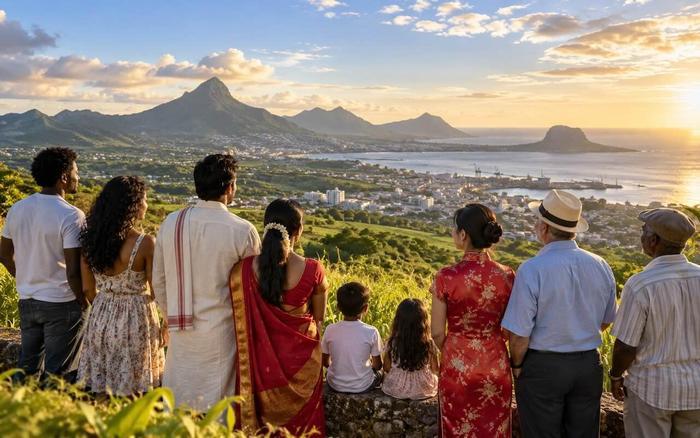
There is something rather wonderful about Mauritius that even people who have lived here all their lives may rarely stop to think about.
Originally, there were no Mauritians.
There was no indigenous population, no ancient Mauritian tribe, no villages, no king and no government. Arab sailors probably knew of the island during the Middle Ages and Portuguese navigators visited during the early 1500s, but neither established a permanent population.
For thousands of years, this beautiful volcanic island in the Indian Ocean was essentially uninhabited.
Everything that eventually became Mauritius came later.
And that makes what Mauritians have built here rather extraordinary.
Three European Powers in 330 Years
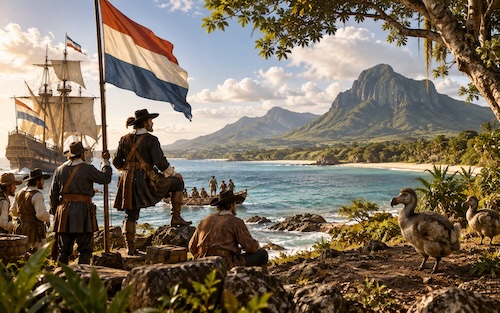
The Dutch landed in 1598 and gave Mauritius the name it still carries, in honour of Prince Maurice of Nassau. But they did not attempt permanent settlement until 1638.
Their colonial presence lasted, with interruptions, until 1710, when they finally abandoned the island.
Dutch settlement: 1638–1710, 72 years.
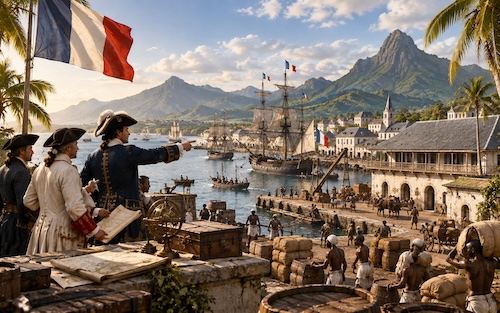
Five years later, France claimed the abandoned island and renamed it Isle de France. Permanent French occupation began in earnest in 1721, and Port Louis developed into an important naval and commercial centre, particularly under Governor Mahé de Labourdonnais.
French rule: 1715–1810, 95 years.
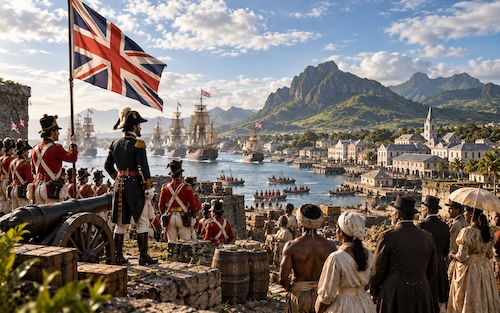
The British captured the island in December 1810 during the Napoleonic Wars. Mauritius returned to its old name, but the British allowed much of the existing population's language, religion, property and legal traditions to continue.
British rule lasted until Mauritius achieved independence on 12 March 1968.
British rule: 1810–1968, 158 years.
So within 330 years, this small island was shaped successively by the Dutch, French and British.
Yet those three European powers are only part of the story.
The People Who Created Mauritius
The French developed Mauritius partly through the labour of enslaved people brought principally from Africa and Madagascar.
Slavery was finally abolished under British rule in 1835. But the rapidly expanding sugar industry still needed enormous numbers of workers, and the British increasingly turned to India.
What happened next transformed Mauritius forever.
Between 1834 and 1910, around 455,000 Indian men, women and children arrived in Mauritius under the indentured labour system.
But what exactly did being an indentured labourer mean?
Unlike an enslaved person, an indentured labourer was legally free. He or she agreed to work for an employer for a fixed period, generally five years, receiving wages under the terms of a contract.
In practice, life could be extremely hard. These workers had travelled thousands of kilometres from home, often worked and lived under difficult conditions and had relatively little power when dealing with plantation owners and colonial authorities. Abuses during the early years became serious enough that Indian indentured immigration to Mauritius was temporarily suspended between 1839 and 1842.
So indenture was not slavery, but neither should we romanticise it.
And its scale was enormous.
Of the roughly 455,000 Indian indentured immigrants who arrived between 1834 and 1910, approximately 290,000 remained in Mauritius, while about 165,000 eventually returned to India or migrated elsewhere.
Think about what that meant for such a small island.
Almost half a million people arrived from India in less than 80 years.
They included both Hindus and Muslims, and their descendants fundamentally changed the demographic, religious and cultural character of Mauritius. It helps explain why Indian traditions remain such an important part of Mauritian life today and why Hinduism became the country's largest religion.
The evidence is everywhere, in family names, temples and mosques, food, languages, music and festivals.
The Aapravasi Ghat in Port Louis, through which so many immigrants passed, is today a UNESCO World Heritage Site. According to the Aapravasi Ghat Trust Fund, the ancestors of more than 70% of today's Mauritian population passed through the immigration depot.
That is an extraordinary connection between modern Mauritians and one small piece of ground beside Port Louis harbour.
Mauritius also became the first major testing ground for the British Empire's system of indentured labour migration, which subsequently spread to other parts of the world and ultimately involved more than two million indentured labourers.
Chinese traders and immigrants added another important community, while descendants of Europeans, Africans and Malagasy remained part of the developing society.
Mauritius was becoming something that had never existed before.
A country made almost entirely from people whose ancestors came from somewhere else.
Three Colonial Powers: Rare, But Not Unique
Mauritius is not the only modern country to have experienced three successive European colonial administrations.
One particularly interesting comparison is Sri Lanka, where the Portuguese, Dutch and British each exercised colonial control.
But there is an important difference.
Sri Lanka already possessed an indigenous population, established kingdoms and a civilisation stretching back thousands of years when Europeans arrived.
Mauritius did not.
There was no ancient Mauritian population for newcomers to join.
The newcomers themselves eventually became the Mauritian population.
Then Mauritius Did Something Remarkable
When Mauritius gained independence on 12 March 1968, there was no guarantee that this experiment would succeed.
It was a tiny island thousands of kilometres from its major markets, with few natural resources, significant unemployment and an economy heavily dependent upon one crop: sugar.
Yet what happened over the following half-century has made Mauritius one of Africa's most interesting development stories.
The World Bank describes Mauritius as having transformed from a low-income, sugar-dependent economy in the 1960s into a diversified upper-middle-income country.
The numbers are impressive.
Between 1984 and 2023, the Mauritian economy grew by an average of approximately 4.5% a year, while real GDP per person tripled within a generation.
Sugar was joined by manufacturing, tourism, financial services, information technology and other industries. Mauritius even briefly crossed into the World Bank's high-income country category in 2020 before the economic shock of the pandemic pushed it back into the upper-middle-income group.
But perhaps Mauritius's most impressive achievements aren't purely economic.
It built a functioning parliamentary democracy in a region where democracy has often struggled.
Governments have lost elections. Oppositions have taken office. Political power has repeatedly changed hands through the ballot box.
The Economist Intelligence Unit's 2024 Democracy Index ranked Mauritius 20th in the world, with a score of 8.23 out of 10, placing it among the relatively small group of countries classified as full democracies.
The 2024 Ibrahim Index of African Governance ranked Mauritius 2nd out of 54 African countries for overall governance, with a score of 72.8 out of 100, compared with an African average of 49.3.
Human development tells another encouraging story.
The United Nations' 2025 Human Development Report gave Mauritius an HDI of 0.806, placing the country within the “very high human development” category.
Education has also improved. The 2022 census found that 91.9% of Mauritians aged ten and above were literate, up from 90.1% in 2011.
Those are impressive achievements for any country.
For a small island that entered independence with few natural resources, dependence on sugar and a population descended from people brought together from several continents, they deserve a little more attention.
And then there is something much harder to measure.
Mauritians learned how to live together.
Look at the Mauritian calendar.
Divali. Eid-ul-Fitr. Christmas. Chinese Spring Festival. Maha Shivaratree. Thaipoosam Cavadee. Ganesh Chaturthi.
Look at the places of worship. Hindu temples, mosques, Catholic churches, Tamil temples and Chinese pagodas can stand only a few kilometres apart.
Look at the food.
Dholl puri, biryani, boulettes, mine frite, rougaille and gâteau piment all comfortably belong in the same country.
Listen to people talking and you may hear Creole, French and English within minutes of one another, alongside languages and traditions inherited from India and China.
Perhaps this is the statistic that nobody can quite calculate.
Mauritius did not create national unity by asking everybody to become the same.
It created something Mauritian on top of all those differences.
And that may ultimately be one of the country's greatest achievements.
Pride Doesn't Mean Pretending Everything Is Perfect
Of course Mauritius is not perfect.
Its history includes slavery, indentured labour, exploitation and periods of serious communal tension. Modern Mauritius still faces inequality, environmental pressures, political controversies, an ageing population and difficult questions about its future economic competitiveness.
Even some of the international indicators that rank Mauritius highly show areas where the country has slipped and needs to improve.
But acknowledging those problems doesn't diminish the achievement.
It makes it more meaningful.
Mauritian history is not a story about different peoples arriving on a perfect tropical island and living happily ever after.
It is the story of people with enormously different backgrounds gradually learning how to build one country together.

Something Called a Mauritian
Perhaps that is why Mauritius deserves a little more appreciation from those fortunate enough to call it home.
The Dutch came and eventually left.
The French came and eventually surrendered the island to Britain.
The British governed Mauritius for 158 years and eventually left too.
Africans and Malagasy arrived, many against their will. Hundreds of thousands came from India under the indentured labour system. Chinese families crossed another ocean to build lives here. Europeans stayed.
Children were born. Families grew. Generation followed generation.
And somewhere along the way, something remarkable happened.
People whose ancestors had once been African, Malagasy, Indian, Chinese, French, British and many other things acquired another identity.
Mauritian.
The Dutch gave the island its name. The French left a profound linguistic and cultural inheritance. The British left institutions and constitutional traditions. Africans, Malagasy, Indians, Chinese and Europeans supplied the people.
But ultimately, Mauritians created Mauritius.
Mauritius began as an island without a people.
More than four centuries later, around 1.2 million people from remarkably different ancestral backgrounds can look at this same small island in the Indian Ocean and share something their ancestors could not: a country, a national identity and a name for themselves.
Mauritian.
And perhaps, for those fortunate enough to call Mauritius their country, that is one of the very best reasons to be proud of it.
Scott Oliver is a retired British writer and independent researcher living in Mauritius. A former Royal Marines Commando and former Wall Street investment professional, he has spent more than four decades living and working internationally across 14 countries. During that time, he worked extensively in international wealth management, cross-border asset protection, international business structuring and global residency planning.
Today, Scott's focus is no longer on managing money or providing professional advice. Instead, through MauritiusWealth.mu, he writes independent educational articles designed to help successful African business owners ask better questions, make better decisions and, when appropriate, identify the right expertise to help protect everything they have spent a lifetime building.
His articles are published solely for general educational and informational purposes and should not be regarded as legal, financial, tax, immigration, investment or other professional advice. Every business owner's circumstances are unique, and readers requiring professional assistance should always consult an appropriately qualified and licensed professional.