
Queen Mary's Church in Poudre D'Or, Mauritius
Tucked away on the peaceful northeastern coast of Mauritius, Poudre d'Or is a village where history and legend come together.
Its name, Poudre d'Or means “Powder of Gold,” is believed to have been inspired by the golden colour of the sand along this beautiful stretch of coastline, a description recorded by the French writer Bernardin de Saint-Pierre during his visit in 1769.
The village dates back to the early French colonial period and grew around the sugar industry, fishing and maritime trade. During the nineteenth century, Poudre d'Or became an important administrative centre and was even connected to Mauritius's northern railway in 1864, helping the surrounding sugar estates flourish.
But Poudre d'Or is best known for one of the island's most famous tragedies. Just offshore lies the reef where the French ship Saint-Géran was wrecked in 1744, a disaster that later inspired the internationally acclaimed novel Paul et Virginie.
Today, a seaside memorial marks the site and attracts visitors from around the world who come to discover one of Mauritius's best-loved stories.
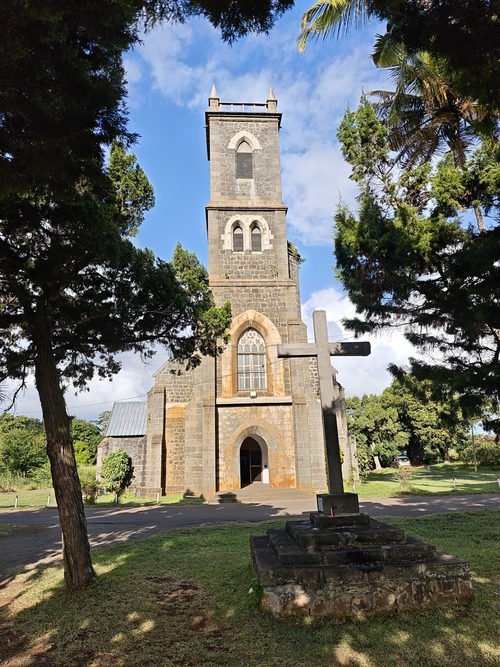
The village is also home to the beautiful Marie-Reine Church, built in 1846, one of the oldest Catholic churches in northern Mauritius, as well as several historic colonial buildings that reflect the area's rich heritage.
Marie-Reine Church was originally dedicated to St. Philomena and traces its origins back to 1846, when local benefactor Madame Baudot donated the land for both the church and its cemetery.
Construction was led by the young Irish priest Father Pierce Michael Comerford, who oversaw the building of the impressive basalt-stone church that still stands today. Just two years later, in January 1848, the church was solemnly consecrated in the presence of Blessed Jacques-Désiré Laval, one of the most revered figures in Mauritian Catholic history.
Built in a striking Norman architectural style, with thick basalt walls and a distinctive bell tower, the church has survived nearly two centuries of tropical weather and cyclones with remarkably few changes to its original appearance.
For more than 175 years, it has served generations of Mauritian families through baptisms, weddings, funerals and daily worship, becoming not only a place of faith but an enduring symbol of the island's cultural heritage.
During the 1960s, following changes to the Catholic liturgical calendar, the parish was renamed Marie-Reine, or Mary Queen, although many Mauritians still affectionately remember it as St. Philomena's Church.
Today, Marie-Reine Church remains one of northern Mauritius's finest historic landmarks, a beautiful reminder of the island's rich Catholic heritage, its French and Irish influences, and the enduring faith of the community that has gathered here for nearly two centuries.
Scott Oliver is a retired British writer and independent researcher living in Mauritius. A former Royal Marines Commando and former Wall Street investment professional, he has spent more than four decades living and working internationally across 14 countries. During that time, he worked extensively in international wealth management, cross-border asset protection, international business structuring and global residency planning.
Today, Scott's focus is no longer on managing money or providing professional advice. Instead, through MauritiusWealth.mu, he writes independent educational articles designed to help successful African business owners ask better questions, make better decisions and, when appropriate, identify the right expertise to help protect everything they have spent a lifetime building.
His articles are published solely for general educational and informational purposes and should not be regarded as legal, financial, tax, immigration, investment or other professional advice. Every business owner's circumstances are unique, and readers requiring professional assistance should always consult an appropriately qualified and licensed professional.