
If You're Doing Business With China, You Already Have Currency Risk, Whether You See It or Not
Most African businesses believe they are operating in dollars. In reality, many are already exposed to multiple currencies without fully understanding where that risk sits, how it moves, or how much it is quietly costing them.

The Illusion of a Dollar-Based Business
Ask a CEO what currency their company operates in, and the answer is often immediate. Dollars.
Revenue may be priced in dollars. Contracts may be referenced in dollars. Financial reporting may be presented in dollars. On the surface, everything appears aligned.
But follow the actual flow of money.
Suppliers may be paid in yuan. Equipment may be sourced through Chinese contractors. Financing may be linked to Chinese institutions. Debt obligations may not perfectly match incoming revenue. Settlement timing may introduce additional exposure.
The business appears dollar-based. The reality is more complex.
And complexity without structure creates risk.
Currency Risk Is Already Inside the Business
Many executives think of currency risk as something external. A sudden movement in exchange rates. A macroeconomic event. A problem that appears when markets become unstable.
In practice, the risk is already embedded in the structure of the business itself.
Each time revenue is received in one currency and expenses are paid in another, a gap is created. Each time a contract is priced differently from the underlying cost base, a mismatch develops. Each time payments are routed inefficiently, additional exposure is introduced.
These are not rare events. They are daily operations.
The risk is not whether currency exposure exists. The risk is that it is not being managed deliberately.

Where It Shows Up First
Currency risk rarely appears as a single, obvious loss. It shows up in quieter ways.
Margins become less predictable. Pricing decisions become more cautious. Cash flow feels tighter than expected. Small discrepancies appear between projected and actual outcomes.
These effects are often attributed to general market conditions. In reality, they are frequently the result of misaligned currency flows.
Over time, this creates a subtle but consistent erosion of value.
The Double Conversion Problem
One of the most common sources of hidden cost is repeated currency conversion.
A business may receive revenue in dollars, convert part of it into local currency, and then convert again into yuan to pay a supplier. Each step introduces cost. Each step introduces timing risk. Each step creates a spread that is rarely measured precisely.
Individually, these costs may appear small. Over a year, across multiple transactions, they become material.
The issue is not simply the exchange rate. It is the structure of the flow.

This Is Not About Predicting Markets
Many businesses approach currency risk by trying to predict movements. Will the dollar strengthen. Will the yuan weaken. Should exposure be hedged at a particular moment.
These questions matter. But they are secondary.
The primary issue is structural. If the underlying flow of the business is misaligned, even stable exchange rates can create inefficiencies. If the structure is sound, volatility becomes easier to manage.
In other words, the goal is not prediction. The goal is control.
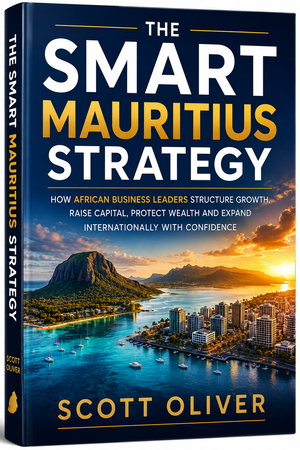
Free Chapter
The SMART Mauritius Strategy
Discover how African business leaders use smarter structures to raise capital, protect wealth and expand internationally.
Download NowWhere Strategy Replaces Assumption
At a certain level of complexity, currency stops being a finance function and becomes a strategic decision.
Where should revenue be held. In what currency should liabilities sit. How should supplier payments be structured. Which jurisdiction should sit between counterparties. How can flows be aligned so that conversions are reduced rather than multiplied.
These are not technical details. They determine how efficiently the business operates.
The companies that address these questions early gain clarity. The ones that delay continue operating with hidden friction.

Why Mauritius Enters the Picture
As businesses begin to recognise that they are operating across multiple currencies, the question becomes where these flows should be managed.
Mauritius offers a stable, internationally recognised platform where multiple currencies can be handled within a single legal and financial framework. It provides access to a well-regulated banking system, established cross-border structuring expertise, and growing connectivity to Africa–Asia trade flows, including those involving the yuan.
This does not replace existing banking relationships. It creates a layer of organisation above them.
For businesses dealing with China, that layer can make the difference between reactive currency exposure and structured currency management.

The Shift Most CEOs Have Not Yet Made
The assumption that international business operates in a single dominant currency is becoming less accurate.
The reality is that many businesses are already multi-currency. They simply have not acknowledged it.
The shift that matters is not from one currency to another. It is from assumption to awareness, and from awareness to structure.
Once that shift is made, decisions become clearer. Costs become more visible. Risk becomes more manageable.
The Bottom Line
If your business is connected to China in any meaningful way, currency risk is already part of your operation.
The question is not whether it exists. The question is whether you can see it clearly, and whether you are managing it by design rather than by default.
The companies that take control of their currency structure do not eliminate risk. They decide where it sits, how it moves, and how much it costs.
Scott Oliver is a retired British writer and independent researcher living in Mauritius. A former Royal Marines Commando and former Wall Street investment professional, he has spent more than four decades living and working internationally across 14 countries. During that time, he worked extensively in international wealth management, cross-border asset protection, international business structuring and global residency planning.
Today, Scott's focus is no longer on managing money or providing professional advice. Instead, through MauritiusWealth.mu, he writes independent educational articles designed to help successful African business owners ask better questions, make better decisions and, when appropriate, identify the right expertise to help protect everything they have spent a lifetime building.
His articles are published solely for general educational and informational purposes and should not be regarded as legal, financial, tax, immigration, investment or other professional advice. Every business owner's circumstances are unique, and readers requiring professional assistance should always consult an appropriately qualified and licensed professional.