
Mauritius 2050: Africa's Financial Capital

What would it take for a small island nation of 1.2 million people to become the preferred home for African capital, talent, and enterprise?
On a typical weekday morning somewhere in Africa, an entrepreneur is making a decision that will shape the future of a company. The discussion may be taking place in Lagos, Nairobi, Johannesburg, Accra, Kigali, Cairo, or Cape Town. Revenue is growing. New markets are opening. Investors are becoming interested. A business that began as a local success story is becoming something larger.
At that point, the questions change. The discussion is no longer limited to products, customers, and sales. The conversation becomes strategic.
- Where should the holding company be based?
- Where should regional expansion be coordinated?
- Where should future acquisitions be managed?
- Where should family wealth be protected?
- Where should succession planning take place?
- Where should future generations inherit and govern the value being created today?
These questions may appear administrative. In reality, they sit at the heart of modern wealth creation. Every successful economy eventually discovers that creating capital and organizing capital are two very different challenges.
For decades, many of the answers have pointed outside Africa. London, Geneva, Luxembourg, Dubai, Singapore, New York, and other international financial centres became magnets for capital because they offered something that investors value above almost everything else: confidence.
Capital rarely migrates toward excitement. It migrates toward trust.

The Question Behind the Question
Most discussions about Africa focus on growth. Growth in population. Growth in cities. Growth in infrastructure. Growth in entrepreneurship. Growth in technology. All of these trends matter. Yet beneath them lies a deeper question that receives far less attention.
Where will African capital live?
Not merely where will it be invested. Not merely where will it be taxed. Where will it be governed, protected, administered, and transferred from one generation to the next?
As African businesses become larger and more sophisticated, the need for trusted platforms becomes increasingly important. Entrepreneurs need structures that support expansion across multiple jurisdictions. Investors need governance frameworks they understand. Family offices need stability. Institutions need predictable rules. Capital markets need credibility.
The future winners will not necessarily be the largest countries. They may be the jurisdictions that reduce uncertainty most effectively.
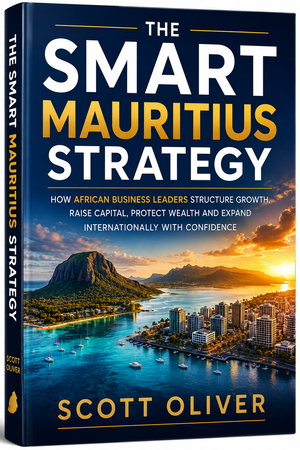
Free Chapter
The SMART Mauritius Strategy
Discover how African business leaders use smarter structures to raise capital, protect wealth and expand internationally.
Download NowThe Singapore Lesson
Whenever small countries discuss economic success, Singapore enters the conversation. Yet Singapore is often misunderstood.
Many observers focus on tax policy, efficiency, or infrastructure. Those factors matter, but they are not the core story. Singapore became successful because it became indispensable. Businesses needed access to its ecosystem. Investors trusted its institutions. Professionals wanted to live there. Universities produced talent. Courts earned credibility. Regulators developed strong reputations.
Over time, a self-reinforcing cycle emerged. Capital attracted talent. Talent attracted enterprise. Enterprise attracted more capital.
The lesson for Mauritius is not that it should attempt to become another Singapore. History cannot be copied. The lesson is that small jurisdictions can become disproportionately important when they solve problems for larger regions around them.
Singapore became one of Asia's trusted platforms. The strategic question for Mauritius is whether it can become one of Africa's.

Africa's Capital Opportunity
The continent is entering a fascinating period. Entrepreneurial ecosystems are maturing. Technology adoption continues to accelerate. Cross-border trade is expanding. Private equity, venture capital, family offices, and institutional investors are becoming more active.
This growth creates a new challenge. Wealth requires architecture. Successful founders eventually need governance. Growing companies eventually need regional structures. Investors eventually need platforms capable of supporting larger pools of capital.
Historically, much of that architecture was located outside Africa. That reality may gradually change.
The question is not whether Africa will create more capital. It almost certainly will. The more interesting question is whether Africa will also create institutions capable of organizing that capital.
Why Mauritius Matters
At first glance, Mauritius appears an unlikely candidate. It is a small island nation with a modest population and a limited domestic market. Yet those apparent limitations conceal significant strengths.
Mauritius enjoys political stability, a respected legal framework, bilingual capabilities, international financial expertise, and decades of experience operating as a bridge between markets. It has developed relationships with banks, regulators, professional firms, investors, and multinational organizations.
Most importantly, Mauritius possesses reputation.
In finance, reputation functions like compound interest. It accumulates slowly. It can take decades to build and moments to damage. Jurisdictions that become successful financial centres tend to protect reputation as carefully as they protect infrastructure.
This is where Mauritius begins with a meaningful advantage.

The Demographic Paradox
Most African countries face a familiar challenge: how to create enough jobs for rapidly growing populations.
Mauritius increasingly faces a different challenge: how to find enough skilled people to fill available opportunities.
Its fertility rate is among the lowest in Africa. Its population is aging. Its demographic profile increasingly resembles developed economies rather than many emerging markets.
At first glance, this appears to be a weakness. It may also become a strategic advantage.
Countries facing demographic maturity must become serious about productivity, education, talent attraction, and technology. They cannot rely solely on population growth. They must focus on quality, capability, and value creation.
In a world where human capital increasingly matters more than natural resources, that distinction may become extremely important.

Twelve Pillars of Africa's Financial Capital
- World-Class Governance. Capital needs predictable institutions. Strong governance creates confidence.
- Trusted Regulation. The objective should not be to become the easiest jurisdiction, but one of the most respected.
- Capital Formation. Mauritius should aim to become a platform where African capital is organized and deployed.
- Modern Capital Markets. Growth companies need better pathways between local financing and large public markets.
- Human Capital. Education in finance, technology, law, compliance, risk, and governance should be treated as national infrastructure.
- Talent Attraction. Selective immigration can strengthen capability and international connectivity.
- Digital Government. Administrative excellence reduces friction for investors and entrepreneurs.
- Connectivity. Strong air links support business, investment, and regional integration.
- Innovation. Financial centres must generate ideas, not merely process transactions.
- Livability. Talent chooses places where families can build meaningful lives.
- Global Brand. Mauritius needs to be known not only for tourism, but also for competence and strategic value.
- Execution. Every strategy ultimately succeeds or fails through implementation.
The Real Competition
Mauritius is not primarily competing with other African countries. It is competing with the world's most effective small jurisdictions.
When entrepreneurs choose where to establish family offices, they compare options globally. When funds select domiciles, they compare jurisdictions internationally. When investors evaluate platforms, they think beyond geography.
This means Mauritius must benchmark itself against places such as Singapore, Dubai, Luxembourg, and Switzerland rather than relying on regional comparisons alone.
That is a demanding standard. It is also the only standard that matters if the goal is to attract globally mobile capital.

Mauritius 2050
Imagine Mauritius in 2050.
- A Nigerian founder manages a regional holding company from Mauritius.
- A Kenyan private equity team operates an Africa-focused investment platform there.
- A South African family office coordinates global assets through the island.
- A Ghanaian entrepreneur raises growth capital using Mauritius-based structures. International wealth managers establish Africa-focused teams because their clients increasingly require expertise on the continent.
Universities produce specialists in governance, technology, compliance, and finance. Conferences bring together investors, policymakers, entrepreneurs, and family offices. Research institutions generate insights into African capital flows and economic development.
In that future, Mauritius is not merely a destination. It is an institution. A platform. A place where important financial decisions are made.
Conclusion
The question is not whether Mauritius can become another Singapore. It cannot, nor should it try.
The more interesting question is whether Mauritius can become Africa's most trusted small-state platform for capital, talent, and enterprise.
Africa's next generation of wealth will need governance. Its entrepreneurs will need structures. Its investors will need trusted institutions. Its family offices will need stable platforms. Its businesses will need jurisdictions capable of supporting long-term growth.
Someone will serve that role.
The strategic question is whether Mauritius intends to become that place.
Scott Oliver is a retired British writer and independent researcher living in Mauritius. A former Royal Marines Commando and former Wall Street investment professional, he has spent more than four decades living and working internationally across 14 countries. During that time, he worked extensively in international wealth management, cross-border asset protection, international business structuring and global residency planning.
Today, Scott's focus is no longer on managing money or providing professional advice. Instead, through MauritiusWealth.mu, he writes independent educational articles designed to help successful African business owners ask better questions, make better decisions and, when appropriate, identify the right expertise to help protect everything they have spent a lifetime building.
His articles are published solely for general educational and informational purposes and should not be regarded as legal, financial, tax, immigration, investment or other professional advice. Every business owner's circumstances are unique, and readers requiring professional assistance should always consult an appropriately qualified and licensed professional.
Expert Resources
- Mauritius IFC Strategy – Overview of the long-term vision for the Mauritius International Financial Centre. Read the Mauritius IFC strategy overview
- Economic Development Board Africa Strategy – Mauritius' positioning as an investment and business platform for Africa. Read the EDB Africa strategy
- World Bank Mauritius Overview – Economic background and development profile of Mauritius. Read the World Bank country overview