
The Green Tollbooth: How Technocrats Learned to Monetize the Sky
Climate changes. It always has. That is not the controversial part.
Earth's climate was changing hundreds of millions of years before the first human being appeared and will continue changing long after the last one disappears.
The real controversy is what modern governments, financial institutions, international organizations and technology companies have constructed around the proposition that today's climate represents an unprecedented emergency requiring an equally unprecedented system of measurement, pricing, regulation and economic intervention.
I believe we are watching something much larger than environmental policy being constructed. We are watching the gradual financialization of the natural world and, potentially, something even more important: the construction of an economic architecture capable of measuring, pricing and eventually controlling an extraordinary proportion of ordinary human activity.
You don't need to believe that everyone involved secretly gathered in a room and agreed upon a master plan. You simply have to look carefully at the machinery being built.
First, Measure the Air
Carbon dioxide is invisible. You cannot put a fence around a tonne of it or load it onto a ship. For most of human history nobody owned the atmosphere, and breathing, heating a home or growing food did not require anyone to calculate an associated carbon account.
Modern carbon economics changed that. Governments increasingly measure greenhouse-gas emissions, establish carbon prices and create systems in which permission to emit can acquire an economic value.
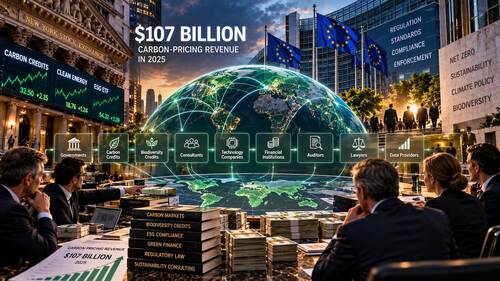
By 2025, according to the World Bank, direct carbon pricing covered more than 29 percent of global greenhouse-gas emissions. Carbon-pricing systems generated more than $107 billion for government budgets that year, up from less than $30 billion in 2016.
There were 87 carbon-pricing policies around the world by 2026, according to the same organization, and every large middle-income economy had either implemented or was planning some form of direct carbon pricing.
Whatever one's view of the environmental justification, something historically remarkable has happened. An invisible atmospheric gas has acquired a price, and once something has a price, something else becomes possible: it can be traded.
Then Create the Market
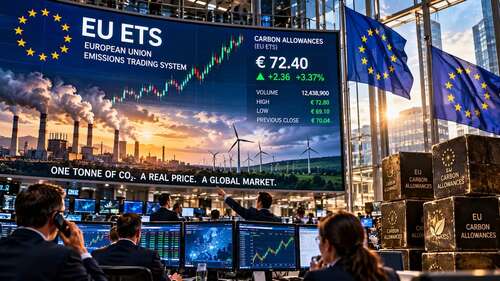
The European Union Emissions Trading System demonstrates the principle. Regulators establish a limit on emissions covered by the scheme, and emission allowances acquire economic value. Businesses covered by the system must account for their emissions and obtain sufficient allowances, which can then be traded.
The economic theory is straightforward: make pollution expensive and businesses have an incentive to produce less of it. But look at what else has been created. Something that previously existed outside conventional property markets has been transformed into an economically scarce instrument because regulation created the scarcity.
Alongside such compliance markets sits another world of carbon credits, in which projects designed to avoid, reduce or remove greenhouse-gas emissions can generate credits with monetary value. Those credits require agreed methodologies for calculating their value, systems for measuring and verifying the underlying claims, recognized standards and registries for recording ownership and transactions. Around that infrastructure grows an entire professional ecosystem of consultants, auditors, lawyers, brokers, technology providers and financial intermediaries.
A new economic ecosystem has therefore emerged around something that, until relatively recently, nobody thought of as a tradable financial commodity. And it doesn't stop with carbon.
From Carbon to Nature
One of the most consequential developments in modern finance is taking place almost unnoticed outside specialist circles. The financialization process is expanding from emissions into nature itself.
The World Economic Forum, working with organizations including the Biodiversity Credit Alliance and the International Advisory Panel on Biodiversity Credits, has published principles intended to help develop a biodiversity-credit market.
The concept sounds superficially attractive. A healthy forest, wetland or coral reef has enormous value to human beings, yet conventional accounting often recognizes little of that value until the resource is commercially exploited. Environmental economists therefore ask a reasonable question: if nature has value, why shouldn't our economic system recognize it?
But that apparently innocent question opens an extraordinary door. Once nature is assigned standardized units of economic value, those units can potentially be bought, sold, financed, bundled and incorporated into financial markets.
In this new financial architecture, a forest is no longer merely a forest. It can be valued for the carbon it stores, while a wetland can be assigned an economic value for the ecosystem services it provides and a habitat can potentially generate biodiversity credits. Attributes of the natural world that once existed largely outside financial markets can therefore be measured, standardized and converted into assets with monetary value.
Supporters call this natural-capital finance. I see something more troubling. The more of the natural world we convert into standardized economic units, the more important it becomes to ask who defines those units, who measures them, who verifies them, who owns the resulting rights and who decides what everyone else is permitted to do with the underlying resource.
The Digital Layer Arrives
Now another development is occurring. The physical economy itself is acquiring a digital information layer.
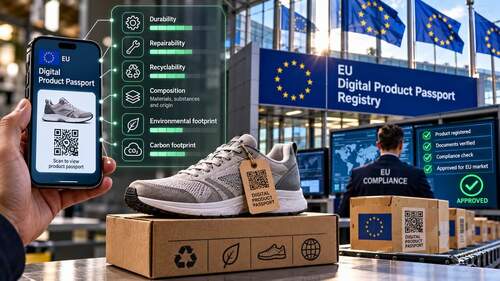
In July 2026, the European Commission launched its Digital Product Passport Registry under the EU's Ecodesign for Sustainable Products Regulation. A Digital Product Passport can contain information about a product's durability, repairability, recyclability, composition, environmental footprint and carbon footprint. Before products covered by the relevant legislation can be placed on the EU market, economic operators will have to register their Digital Product Passports with the EU registry.
The European Commission says the objective is greater transparency, easier regulatory compliance, more informed consumers and a more circular economy. Perhaps those objectives are entirely sincere. But intentions are not the only thing that matters when constructing powerful systems. Capabilities matter too.
Once physical products possess standardized digital identities containing regulatory and environmental information, governments and businesses gain capabilities that previously did not exist at anything approaching this scale. Products can be identified, their characteristics recorded, compliance checked electronically and environmental information attached to them. Rules can determine whether they satisfy regulatory requirements, while customs authorities can verify their status before products enter the European market.
None of that proves some future system of personal carbon rationing. But neither should we pretend that this infrastructure is insignificant. The question citizens should always ask when powerful new administrative machinery is created is not merely what today's administrators promise to do with it, but what that machinery will allow tomorrow's administrators to do.
Measure It, Price It, Digitize It, Regulate It
There is a pattern worth noticing. Something is first measured and standardized, then assigned a value and recorded digitally, before eventually being incorporated into regulation where access can become conditional upon compliance with the rules. This does not require a secret meeting. It is simply how administrative systems acquire power.
The process can produce perfectly reasonable outcomes at every individual stage. Measuring emissions sounds reasonable. Reducing pollution sounds reasonable. Protecting biodiversity sounds reasonable. Providing consumers with better product information sounds reasonable. Digitizing records sounds efficient, and ensuring regulatory compliance sounds responsible.
But political power should not be judged solely by whether every individual component sounds reasonable. It should also be judged by what those components can become when connected.
That is where I become deeply concerned. I believe we are constructing the technological and financial infrastructure through which governments, financial institutions and large technology companies could eventually exercise an extraordinary degree of influence over economic life.
Not because carbon itself possesses magical powers, but because almost everything human beings do requires energy or resources. We heat and cool buildings, drive, fly, manufacture, farm, eat, build, transport goods and generate electricity. Attach a carbon value to economic activity and suddenly an astonishing proportion of human life becomes measurable within the same conceptual system. Attach digital identity and financial infrastructure to that system and the possibilities become considerably greater.
And Then Came Artificial Intelligence
This would already deserve scrutiny. Then AI arrived.
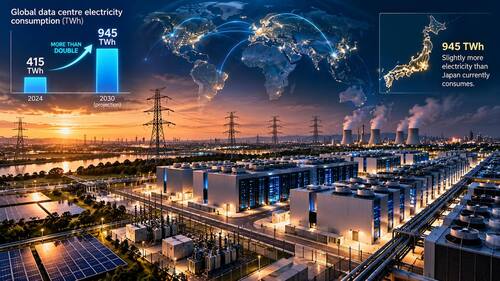
Artificial intelligence requires extraordinary amounts of computing infrastructure, and computing infrastructure requires electricity. According to the International Energy Agency, data centres consumed roughly 415 terawatt-hours of electricity globally in 2024. Its central projection has consumption reaching around 945 terawatt-hours by 2030, more than double today's level and slightly more electricity than Japan currently consumes. AI is the most important driver of that increase.
In the United States, the IEA expects data centres to account for nearly half of electricity-demand growth through 2030. By the end of the decade, American data centres could consume more electricity than the country's production of aluminium, steel, cement, chemicals and other energy-intensive manufactured goods combined.
Not all this additional electricity will come from wind turbines and solar panels. The IEA expects renewables to provide a large proportion of additional generation, but natural gas, coal and nuclear power will also contribute.
There is nothing inherently wrong with using enormous quantities of electricity to build useful technology. But the contrast deserves attention. For years ordinary people have been encouraged to think about their carbon footprints. Governments regulate vehicle emissions, building efficiency, industrial energy use and countless other environmental characteristics. Meanwhile, some of the largest corporations on Earth are constructing one of the most electricity-hungry technological infrastructures humanity has ever created.
Apparently enormous energy consumption remains acceptable when sufficiently powerful economic interests consider the result valuable. That tells us something important. The real question was never simply how much energy humanity consumes. It is increasingly about who consumes it, for what purpose, at what price and under whose rules.
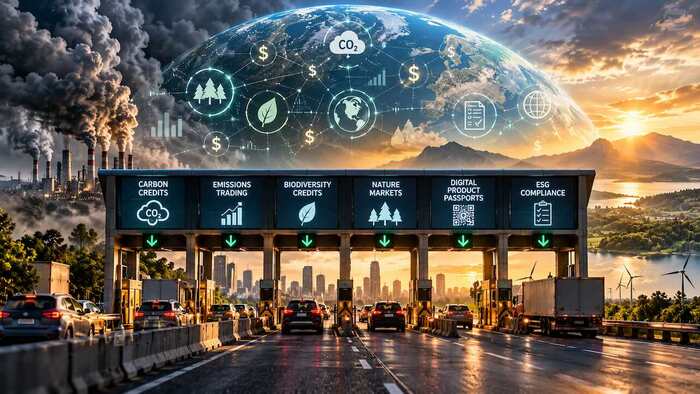
The Green Tollbooth
This is why I think of the emerging system as a tollbooth. A tollbooth does not necessarily prohibit you from travelling. It places an authority between you and the road. That authority measures your passage, establishes the rules, determines the price and decides the conditions under which you proceed.
Now imagine that principle gradually extending beyond roads. Energy, transport, manufacturing, buildings and food production can all be assigned carbon values. Land and forests can acquire environmental and carbon values. Ecosystems can acquire biodiversity values, while physical products increasingly acquire digital environmental records.
At each stage, the justification may sound perfectly reasonable. But eventually we should ask a profoundly important question: How many tollbooths are we willing to place between human beings and ordinary life?
Follow the Money, But Also Follow the Power
It is tempting to view this entirely as another Wall Street opportunity. There is certainly money involved. More than $107 billion in carbon-pricing revenue flowed to governments in 2025 alone. Carbon credits are traded, biodiversity-credit markets are being developed, consultants advise companies about sustainability, technology businesses build compliance systems, financial institutions provide capital, auditors verify information, lawyers interpret regulations and data providers measure increasingly detailed aspects of economic activity.
Whenever governments create a complicated new market, an industry inevitably develops around navigating it. But I increasingly think focusing exclusively on money misses the more important issue.
Money may be the incentive. Control is the capability.
I do not expect the architects of such systems to publish a document entitled Our Plan to Control Your Life. Nor do I need such a document before asking uncomfortable questions. I am more interested in what the machinery makes possible than what its builders currently promise to do with it.
This raises questions that deserve much more public attention: who establishes the methodology and decides what counts, who performs the measurements, who maintains the registries and determines compliance, who owns the resulting data, who can change the rules, who collects the money, who can deny access, and ultimately what happens to an individual or business that refuses to participate?
Those are not trivial questions. They are precisely the questions free societies should ask whenever systems capable of exercising enormous economic power are constructed.
From Financial Abstraction Back to Physical Reality
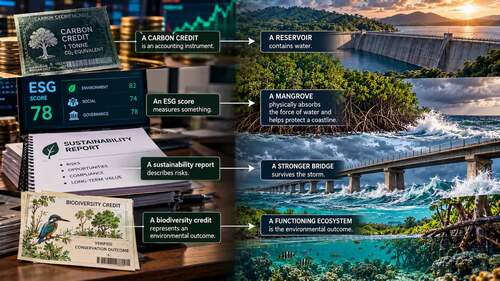
There is another way to think about environmental security. A carbon credit is an accounting instrument; a reservoir contains water. An ESG score measures something; a mangrove physically absorbs the force of water and helps protect a coastline. A sustainability report describes risks; a stronger bridge survives the storm. A biodiversity credit represents an environmental outcome; a functioning ecosystem is the environmental outcome.
This distinction matters. We can build ever more sophisticated systems for measuring, pricing, trading and reporting our relationship with nature, or we can spend more of our resources making the physical world around us cleaner, stronger and more resilient. Obviously, the two approaches do not have to be mutually exclusive.
But there should be one brutally simple test applied to the entire green-finance experiment: After all the conferences, regulations, consultants, credits, registries, taxes, tokens, reports, trading systems and fees, is the physical world actually better?
Are rivers cleaner, forests healthier, infrastructure stronger, water supplies more secure, energy systems more reliable and communities more resilient? If the answer is yes, demonstrate it. If the answer is no, perhaps we should ask what exactly all this machinery is accomplishing.
The Right to Ask
The most dangerous feature of any supposedly existential crisis is the temptation to declare certain questions illegitimate. If the planet is at stake, scepticism becomes irresponsibility. If action is urgent, debate becomes obstruction. If experts have reached a consensus, ordinary people are encouraged to defer.
I reject that completely.
Climate changes. Human activity affects the environment. Pollution should be reduced. Nature should be protected. None of those propositions requires us to surrender our judgment about the political and financial systems being constructed in their name.
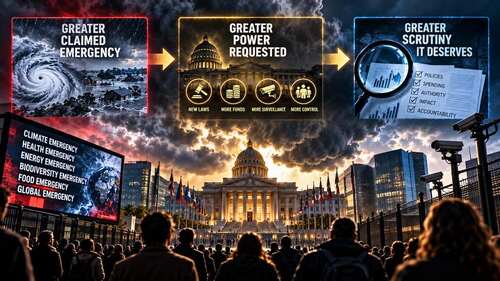
Quite the opposite. The greater the claimed emergency, the greater the power governments and institutions may request, and the greater the power requested, the more scrutiny it deserves.
Perhaps every institution involved in this transformation has entirely benevolent intentions. Perhaps the enormous administrative architecture being constructed will always be used wisely. Perhaps future governments will never abuse capabilities today's governments create.
History gives me little reason to make such assumptions.
The atmosphere belongs to nobody. The rain belongs to nobody. The sunlight belongs to nobody. Nature existed before governments, banks, corporations, carbon markets and digital registries.
We should be extremely cautious about constructing a world in which increasingly large portions of that natural inheritance become measurable financial units administered by institutions ordinary people neither control nor fully understand.
Because once the tollbooths have been built, the most important question may no longer be how much the toll costs.
It may be: Who controls the road?
Scott Oliver is a retired British writer and independent researcher living in Mauritius. A former Royal Marines Commando and former Wall Street investment professional, he has spent more than four decades living and working internationally across 14 countries. During that time, he worked extensively in international wealth management, cross-border asset protection, international business structuring and global residency planning.
Today, through MauritiusWealth.mu, Scott writes independent educational articles designed to help successful African business owners ask better questions, make better decisions and, when appropriate, identify the right expertise to help protect everything they have spent a lifetime building.
His articles are published solely for general educational and informational purposes and should not be regarded as legal, financial, tax, immigration, investment or other professional advice. Every business owner's circumstances are unique, and readers requiring professional assistance should always consult an appropriately qualified and licensed professional.