
Where Three Faiths Share the Same Shore: The Quiet Story of Cap Malheureux Cemetery
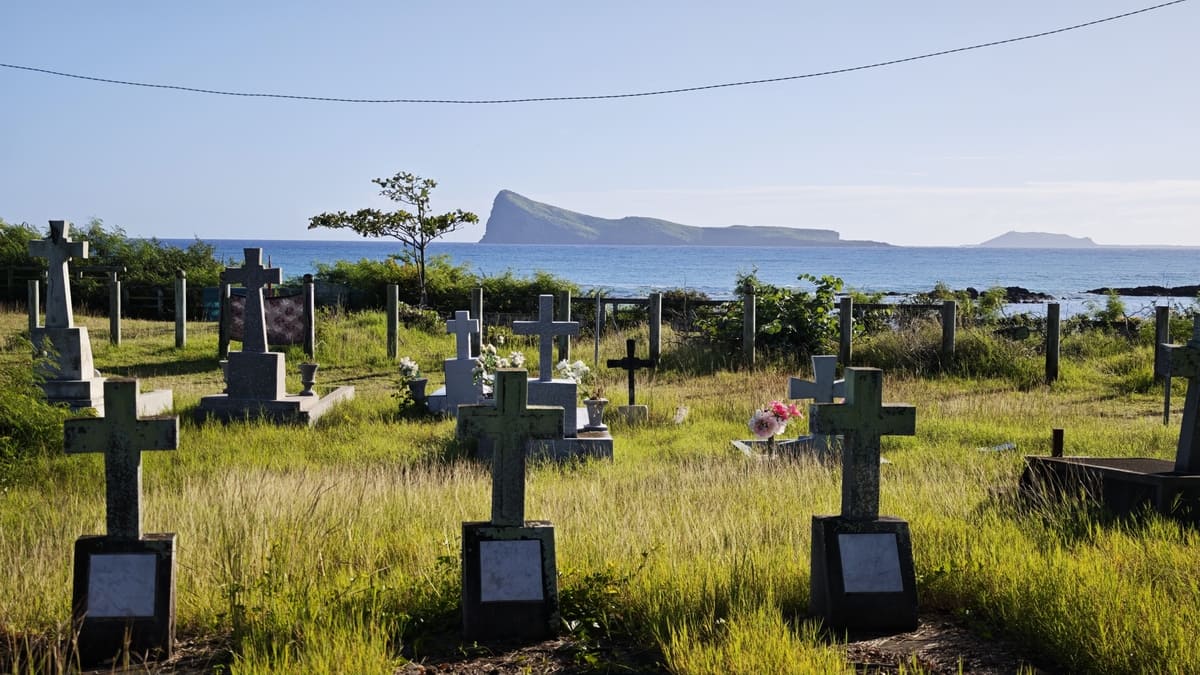
On the northern tip of Mauritius, in the small fishing village of Cap Malheureux, there is a place that almost nobody advertises and many visitors miss.
It sits right beside the sea, a short walk from the famous red-roofed Notre-Dame Auxiliatrice church, with open views toward Coin de Mire. Locals often call it the cimetière marin, the marine cemetery, not because it is poetic, but because it is literally on the edge of the ocean.
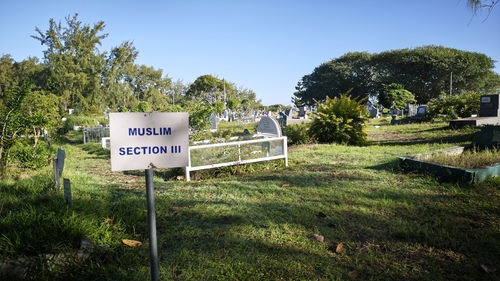
What makes this cemetery unusual is not its scenery, although the light and the horizon give it a quiet gravity. What makes it remarkable is that it is shared by three faiths. Here, Christians, Hindus, and Muslims are buried in the same small coastal ground, in clearly distinct sections, each following its own traditions, symbols, and ideas about death. It is not a blend. It is coexistence.
Mauritius is often described as a multicultural society, a place where people of Indian, African, European, and Chinese origin live together. That can sound like a slogan until you stand in this cemetery and see how different beliefs literally lie side by side, separated by a few steps of sand and coral rock.
A Catholic Landscape of Memory
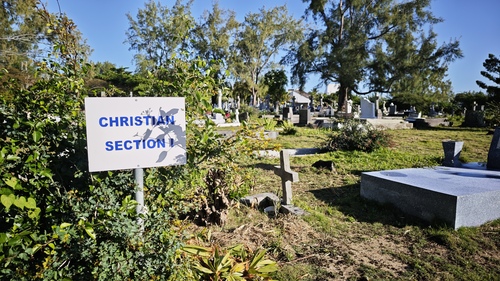
The Christian section, mostly Catholic in this part of the island, is the most immediately familiar to European eyes. Graves are usually rectangular and built in stone or concrete. Crosses rise from many of them. Names and dates are carved or painted, and it is common to see a small ceramic photo of the dead set into the headstone. Some graves hold candles, flowers, or small statues of Mary or a saint.
These graves are not meant to disappear into the landscape. They are meant to be visited. Families clean them, repaint the letters, and come to pray. The Catholic idea behind this is simple and old. The body rests here, waiting for resurrection, and the grave is a place where the living maintain a relationship with the dead. Even in a small village cemetery, you can see how memory is made physical.
The Hindu Idea of Impermanence
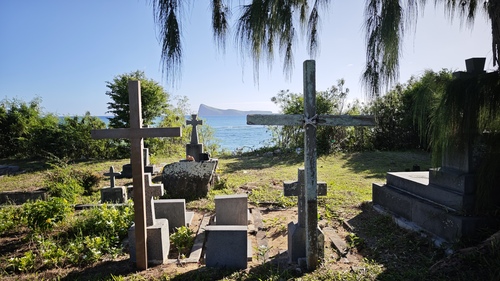
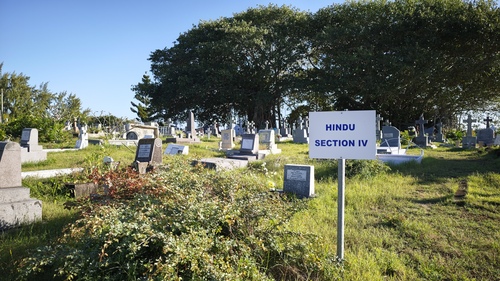
Walk a little further and the visual language changes. In Hindu tradition, the body is usually cremated, not buried. Fire is the means by which the soul is released. Because of that, what you find here is often not a grave in the European sense, but a memorial marker. These may be low platforms, simple plaques, or modest concrete structures that mark remembrance rather than contain a body.
The philosophy behind this is radically different. In Hindu belief, the soul, the atman, is not the body. It moves on, into another form. The physical remains are not the focus. What matters is the continuity of the family line and the ritual honoring of ancestors. In this part of the cemetery, you feel that death is not treated as a final stop, but as a transition.
Islamic Simplicity and Equality
The Muslim section is visually the most restrained. Graves are usually very simple, often just a low rectangular mound or a plain stone structure with one or two small markers. There are no statues, no photos, and no decoration. Many graves are aligned so that the body faces Mecca, as tradition requires.
The meaning is clear. In Islam, death is not a moment for display. It is a moment for humility. The body is buried intact, awaiting the Day of Judgment, and the grave should not elevate one person above another. In this part of the cemetery, status disappears. Simplicity is the message written in stone.
Three Views of the Same Human Fact
What is striking is not only that these three traditions exist here, but how clearly their philosophies are visible. Christianity emphasizes remembrance and the physical marker. Hinduism emphasizes impermanence and ritual continuity. Islam emphasizes modesty and equality before God. Three answers to the same question, placed within a few dozen meters of each other.
In many countries, these communities would have entirely separate burial grounds. Here, they share the same land and the same sea breeze. The boundaries are respected, but the ground is common.
The Ocean as a Silent Witness
The setting changes everything. The ocean is always present, sometimes calm, sometimes restless. Across cultures, the sea has often symbolized eternity, passage, and the idea that life is part of something much larger. In Cap Malheureux, it makes the cemetery feel less like a closed space and more like a threshold.
It is not a gloomy place. It is contemplative. Fishermen pass nearby. Children play in the village. Life goes on within sight of death, and death rests within sight of the horizon.
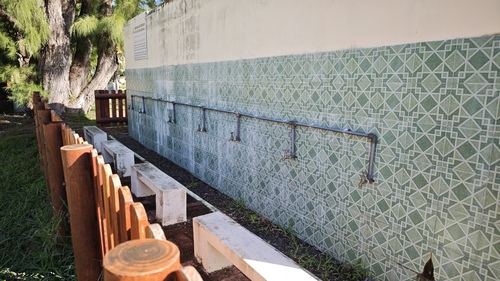
The long rows of faucets (taps) that you see in Muslim graveyards are there for ritual washing (wudu/ablution) before prayer.
A Small Lesson About Mauritius
There are museums and monuments that explain Mauritius' diversity with words and timelines. This cemetery explains it without speaking. It does not pretend that everyone believes the same thing. It shows something more difficult and more honest, that people can live together, and even die together, without needing to become the same.
In a world that often struggles to manage difference, this small, quiet place on the north coast of an island offers a practical, untheoretical example of how coexistence actually looks on the ground.
The Bottom Line
The Cap Malheureux cemetery is not important because it is old, or scenic, or unusual. It is important because it makes an abstract idea concrete. Different beliefs, different rituals, different views of life and death, all sharing the same narrow strip of land by the same sea.
It is Mauritius in miniature, and it is a reminder that peaceful coexistence is not a slogan. It is a daily, practical arrangement, maintained even at the edge of the grave.
Scott Oliver is a retired British writer and independent researcher living in Mauritius. A former Royal Marines Commando and former Wall Street investment professional, he has spent more than four decades living and working internationally across 14 countries. During that time, he worked extensively in international wealth management, cross-border asset protection, international business structuring and global residency planning.
Today, Scott's focus is no longer on managing money or providing professional advice. Instead, through MauritiusWealth.mu, he writes independent educational articles designed to help successful African business owners ask better questions, make better decisions and, when appropriate, identify the right expertise to help protect everything they have spent a lifetime building.
His articles are published solely for general educational and informational purposes and should not be regarded as legal, financial, tax, immigration, investment or other professional advice. Every business owner's circumstances are unique, and readers requiring professional assistance should always consult an appropriately qualified and licensed professional.
Trusted Expert Resources
- Find a Grave – Cap Malheureux Cemetery (Mauritius)
Cemetery listing showing Christian, Hindu, and Muslim sections at Cap Malheureux, with photos and descriptions confirming its multi-faith character. View the cemetery records - Geneanet – Cimetière de Cap Malheureux
Genealogical cemetery database with GPS coordinates and photos of graves from the Cap Malheureux burial ground in Mauritius.
See graves and location data - Cap Malheureux Cemetery on Evendo (Mauritius Travel)
Travel-oriented description of the Cap Malheureux cemetery's seaside setting and cultural significance as a reflective local landmark.
Learn about the site and visit tips - Cap Malheureux village overview
Travel page noting that Cap Malheureux includes a marine cemetery alongside the local church and temple within its small village environment. Read about the village context